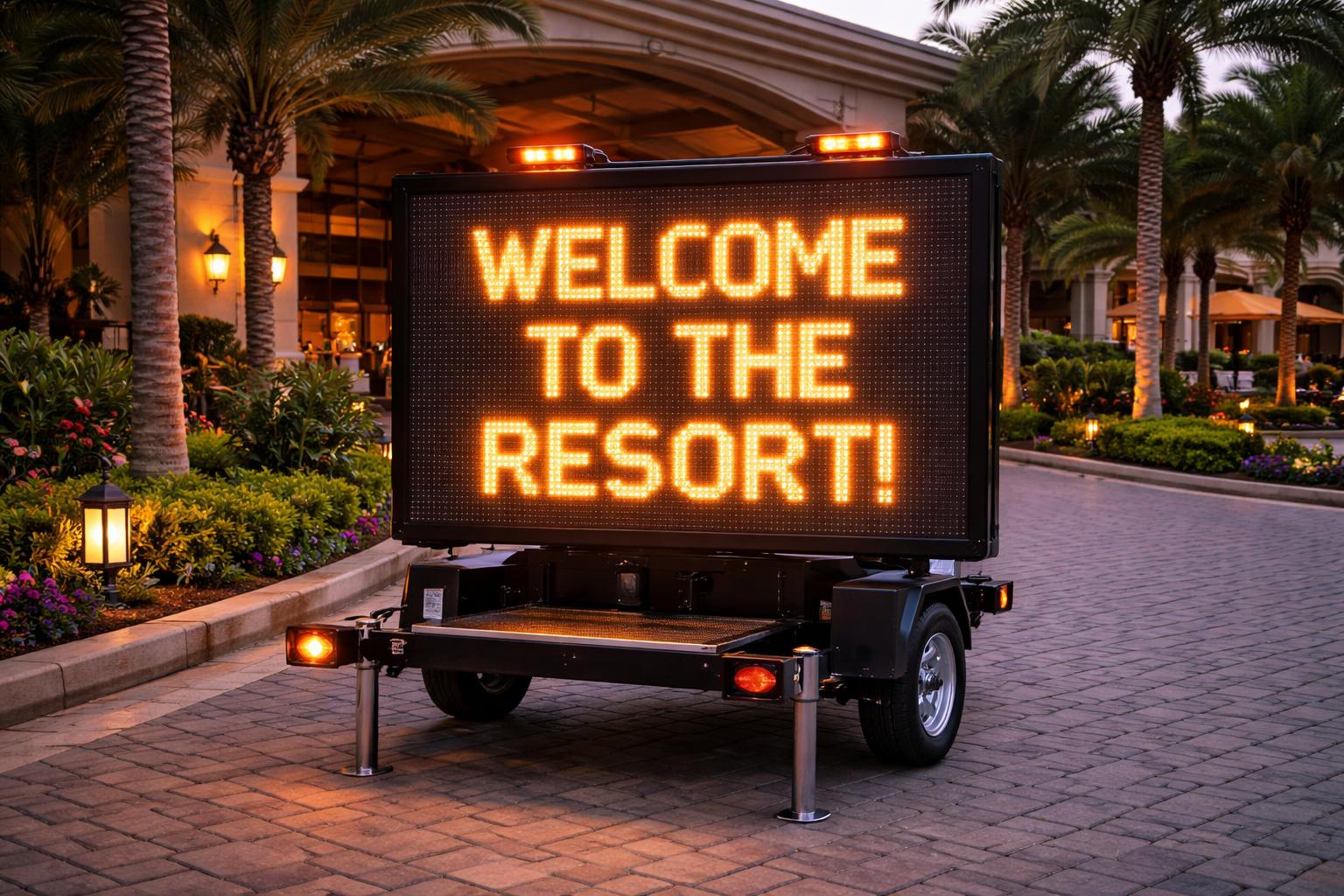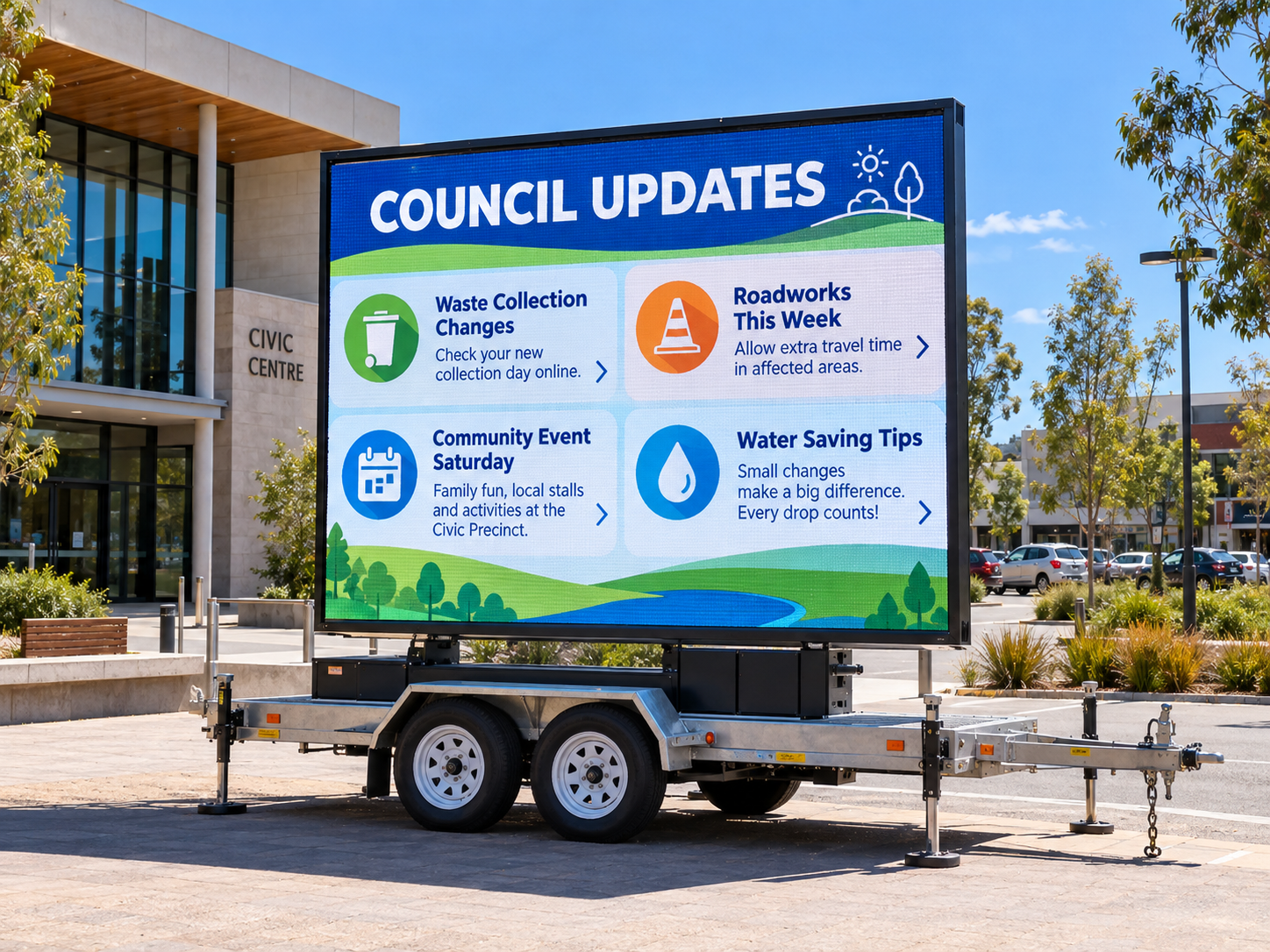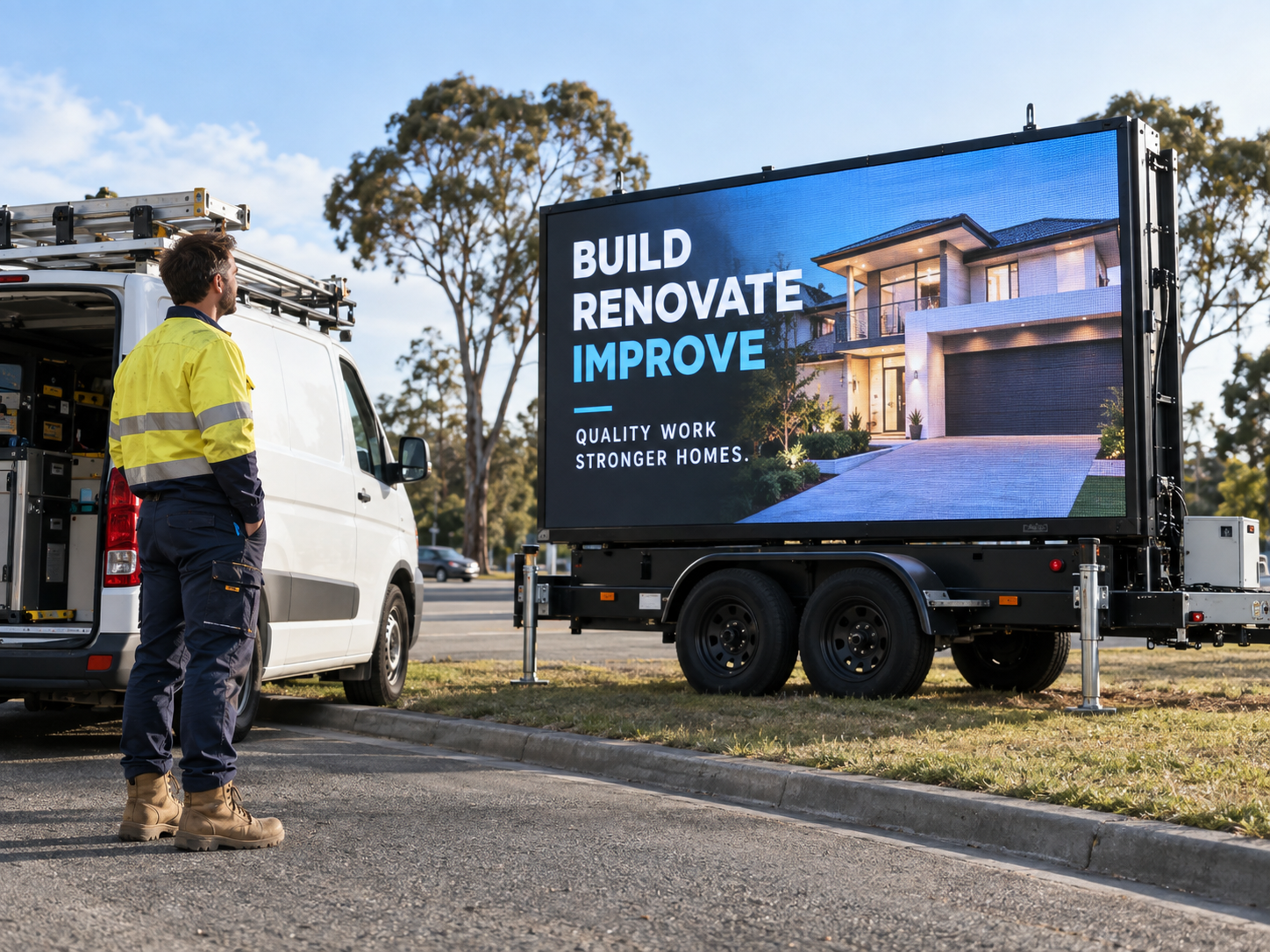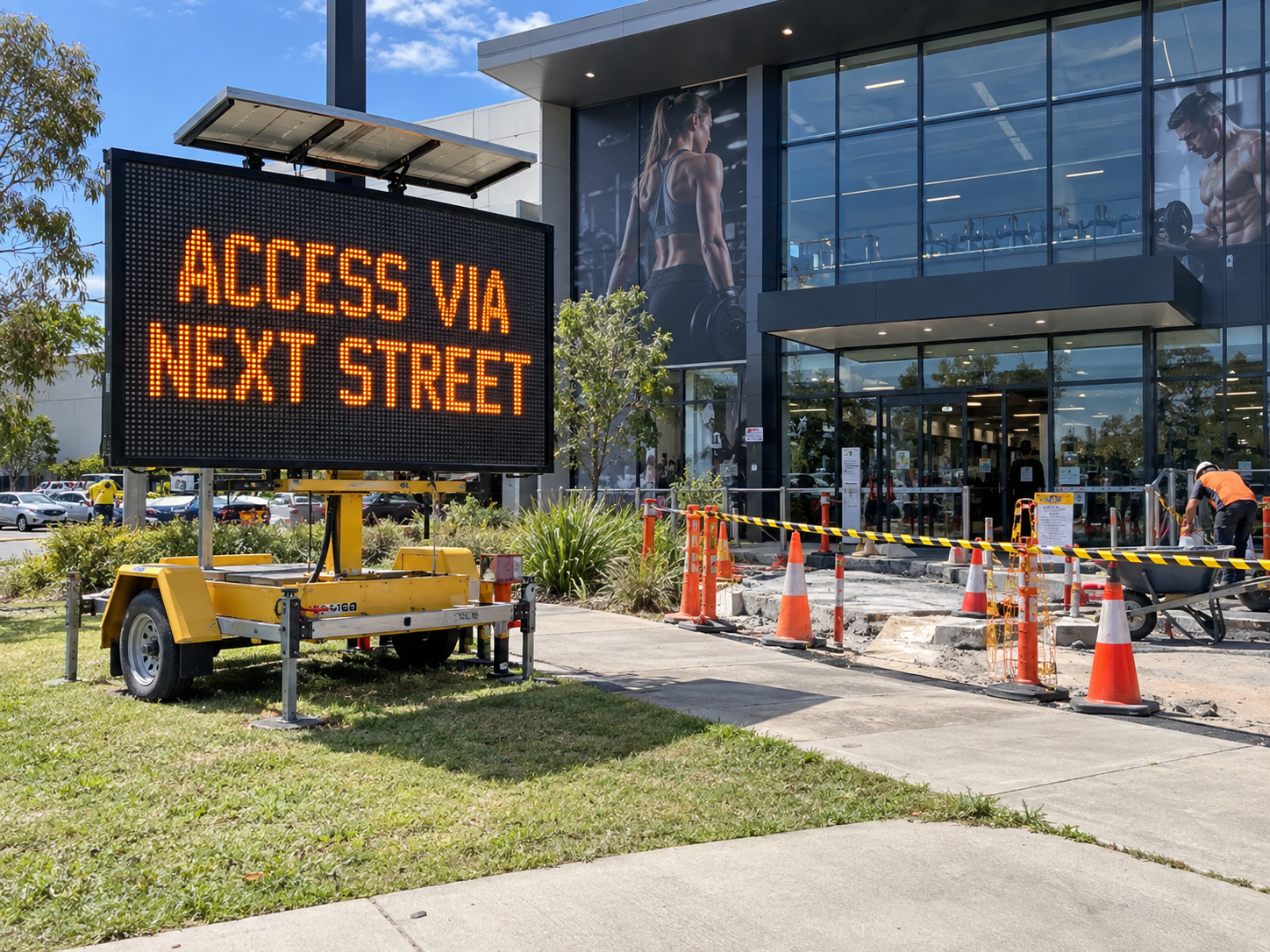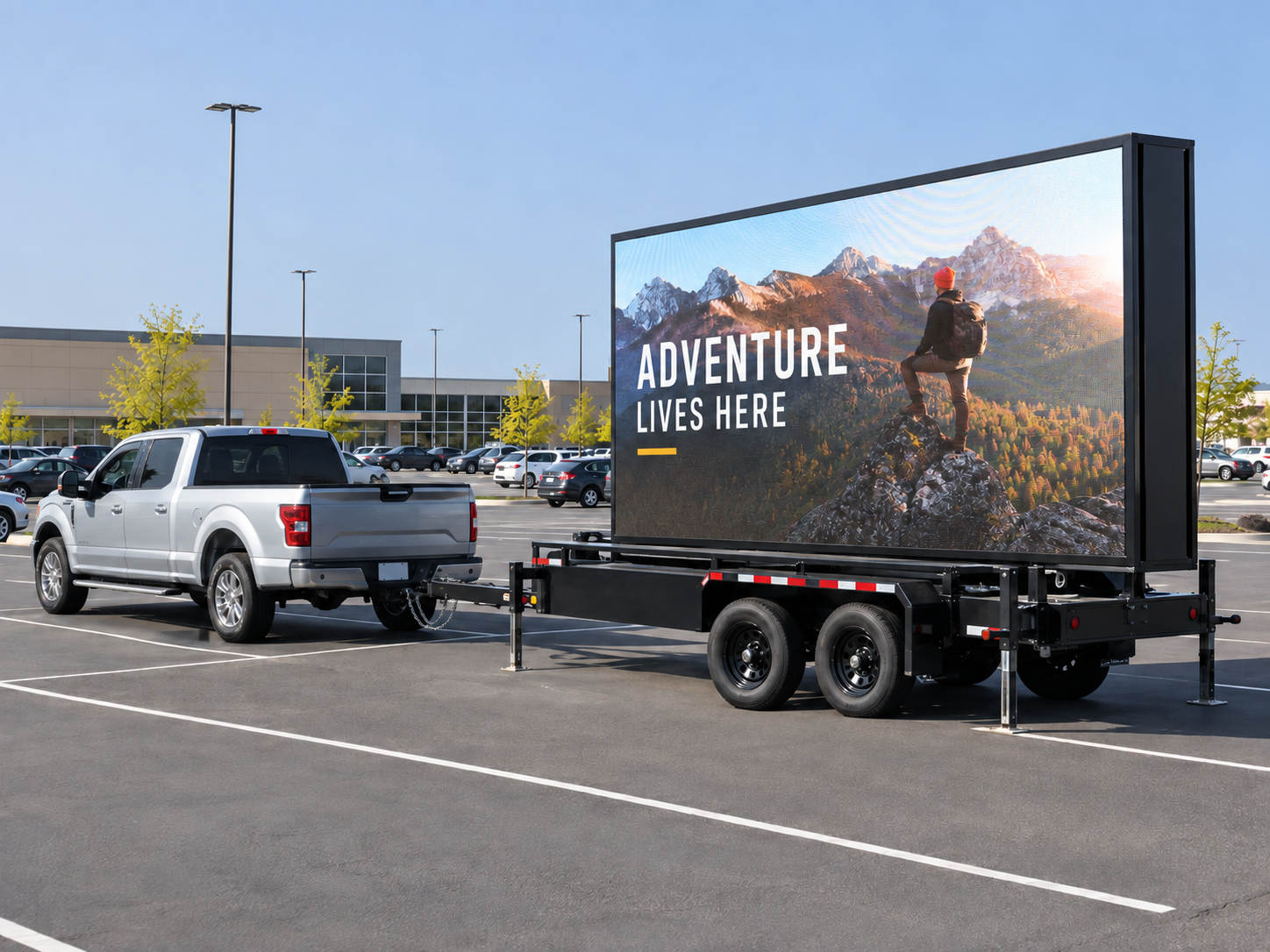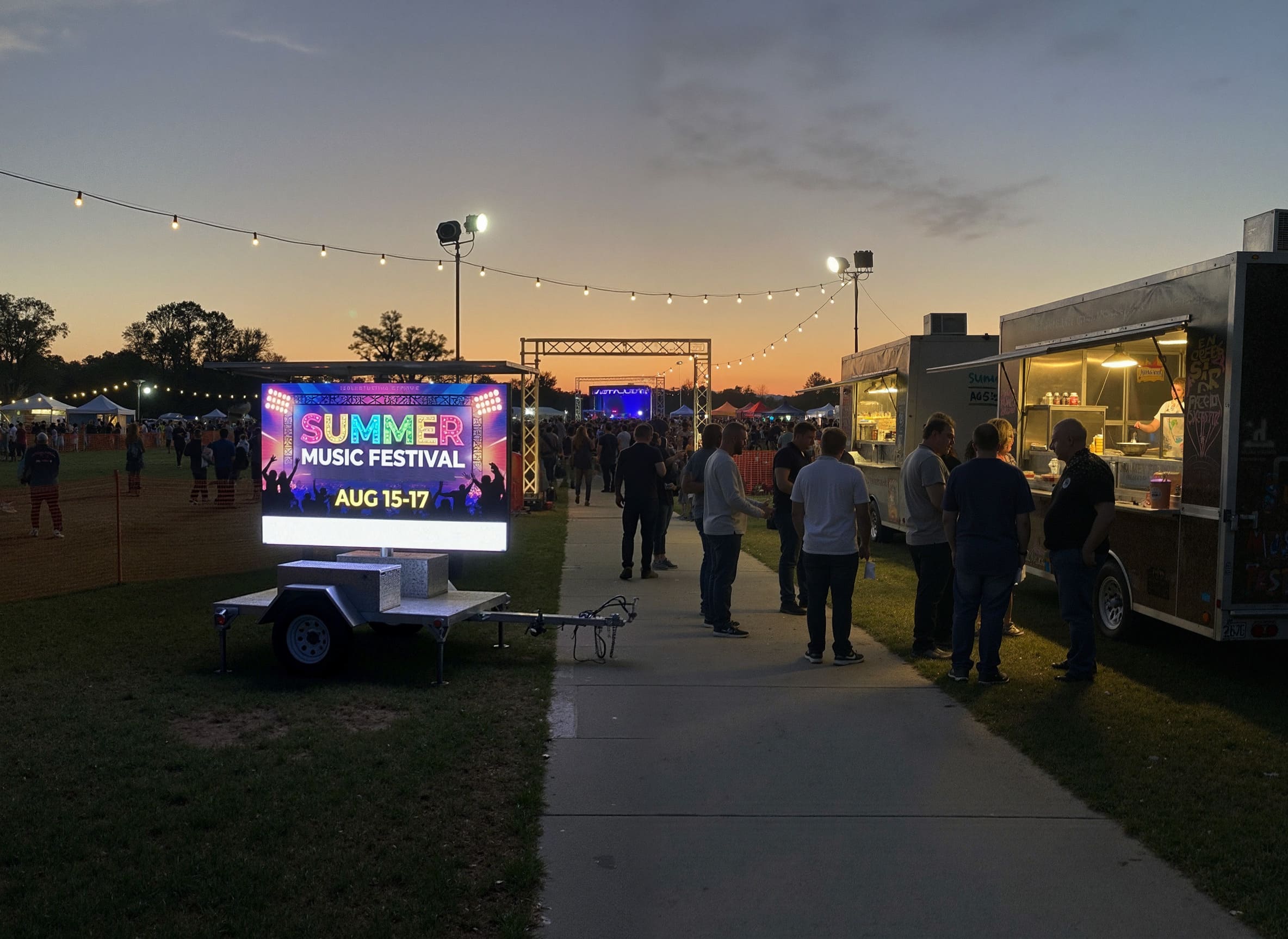
If you are thinking about using a mobile digital billboard in Queensland, one of the first questions is usually the most practical one: where can it actually go? That question matters whether you are planning a short-term promotion, a grand opening, an open home campaign, a community event, a business forecourt activation or a seasonal roadside push. The short answer is that placement is possible in many locations, but it is never just a matter of towing an LED trailer into position and hoping for the best. The lawful answer depends on who controls the land, whether the sign is on private property or public land, whether it is near a state-controlled road, what the local council rules say, and whether the site is safe for road users, pedestrians and neighbouring properties.
That matters because Queensland regulators treat advertising devices as more than marketing assets. Transport and Main Roads says signs and advertising devices in or visible from a state-controlled road corridor are regulated because the state has to protect road safety, traffic efficiency, amenity and environmental values. Local councils apply their own planning schemes, local laws and technical standards, and several councils expressly regulate temporary, permanent and mobile advertising devices. In other words, a mobile electronic billboard, portable LED billboard or digital billboard trailer can be a powerful advertising tool, but it has to fit both the site and the rules.
This is exactly where Signs of Success can add value. Signs of Success promotes solar-powered, self-sufficient mobile LED advertising trailers for hire across the Gold Coast and Brisbane, with remote content updates and flexible deployment from busy intersections to remote event locations. That service model is useful precisely because placement, safety and message visibility need to be thought through before the sign goes out, not after it arrives. A well-placed mobile LED billboard can help a campaign perform; a poorly chosen site can create approval issues, visibility problems or traffic conflicts.
This guide explains the practical side of placing mobile electronic signs in Queensland. It covers private property, shopping centre car parks, club grounds, event sites, business forecourts, local roads and state-controlled roads. It also explains why placement affects not only legal compliance, but also readability, campaign performance, access, towing logistics, night-time operation and ongoing management. If you are weighing up whether to hire mobile LED sign services, rent LED trailer equipment, or even research mobile digital billboards for sale, understanding placement is one of the smartest first steps. The rules do not disappear just because the screen is portable.
The short answer depends on who controls the land
The most important starting point is not the screen size or even the campaign budget. It is land control. In Queensland, the approval path changes depending on whether your proposed mobile digital billboard sits on private property, council-controlled land, a local road, or land that is in or visible from a state-controlled road corridor. Transport and Main Roads makes this distinction very clear: signs in, or visible from, a state-controlled road corridor are subject to state oversight, and the department specifically regulates sign construction, size, design and placement. Local councils, meanwhile, regulate advertising devices through planning schemes and local laws within their own areas.
That is why there is no single Queensland-wide “yes” or “no” to the question of where a mobile led billboard can be placed. A trailer positioned inside a shopping centre car park is a different planning and consent scenario from a trailer parked beside a state-controlled road. A sign on a business forecourt in Brisbane may follow a different approval pathway from the same sign on a Gold Coast service site or a Sunshine Coast event ground. The practical takeaway is simple: first identify the land type, then identify the road authority or council, then check whether planning approval, a licence, landowner consent, or state referral is needed.
In Brisbane, Council’s advertising device approval process explicitly starts with the property zone, environment classification and device type. Brisbane also says that if you are not the landowner, you must supply landowner consent, and that some proposals may also need building approval under the Building Act 1975. On the Gold Coast, Council says you might need a licence or development approval to display a permanent, temporary or mobile advertising sign, and that if approval is needed, it must be in place before the sign is displayed. Sunshine Coast Council goes even further in its fact sheet for portable electronic billboards and variable message signs, spelling out that these devices may be assessed on private property and on council-controlled road reserves, with separate Transport and Main Roads input where state-controlled roads are involved.
This is also why businesses comparing a mobile digital billboard, a mobile electronic billboard or a portable LED billboard should not think about the screen in isolation. The real decision is about the whole deployment environment: landowner permission, traffic conditions, nearby intersections, sight lines, footpaths, parking rules, access for towing, and whether the site will make the message easy to read without compromising safety. Signs of Success is well positioned here because its service is not just about supplying an LED trailer; its website emphasises placement flexibility, local deployment and remote content control, which is exactly what clients need when the site itself is part of the strategy.
Private property, shopping centre car parks and business forecourts
For most advertisers, private property is the simplest and most realistic starting point. If a digital billboard trailer or LED trailer is being placed inside a business site, on a forecourt, on private land beside a store, inside a shopping centre car park or at a privately managed event venue, the first issue is permission from the owner or occupier with the right to authorise the placement. Queensland’s planning guidance is clear that when a development application requires owner’s consent, the application cannot be properly made without it, and Brisbane City Council separately requires landowner consent where the applicant is not the landowner.
That does not mean private property automatically avoids council involvement. In Brisbane, the approval process still turns on zoning, environment classification and device type, and Council notes that heritage overlays trigger full assessment. Brisbane also says new or amended devices can require supporting documents such as accurate site plans, design and construction details, and possibly building approval. On the Gold Coast, Council says a permanent, temporary or mobile advertising sign may need a licence or development approval, and applicants need to provide sign dimensions, illumination details and a site plan. So while private land is often easier than public land, it is not a free-for-all. A mobile led billboard in a shopping centre car park still needs the right owner permission and may still need formal local approval depending on local rules and the proposed use.
Shopping centre car parks are a good example. From a marketing perspective, they can be excellent for a mobile digital billboard because traffic is slower, dwell time is longer and customers are already in a buying mindset. From a compliance perspective, though, they are still private land. Centre management approval is essential, and so is checking whether the sign is treated as an advertising device under the relevant local framework. If the car park fronts a major road, the question of road visibility also becomes more important. A client researching hire mobile led sign options should not assume that because the trailer sits on private asphalt it is automatically exempt from every other control.
Business forecourts are often ideal for campaigns such as open homes, retail promotions, showrooms, fast-food outlets, service centres and grand openings. They usually provide better control over site access, easier maintenance, clearer responsibility and better alignment between the sign and the business being promoted. But they still need practical risk checks. The sign should not obstruct access points, sight lines for vehicles leaving the property, pedestrian movement or any area drivers need to read official traffic controls. Transport and Main Roads specifically says an electronic billboard should not obstruct a driver’s line of sight to official traffic signs, exit ramps, on-ramps, intersections or other road users, and should not sit in close visual proximity to traffic signals or railway signals.
If the private site is next to a state-controlled road, the regulatory picture becomes stricter. Sunshine Coast Council’s portable electronic billboard fact sheet expressly says that portable electronic billboards or VMS on private property adjacent to state-controlled roads require assessment from Transport and Main Roads before Council issues a permit. That is a very practical reminder for clients who want roadside exposure near arterials and major corridors: private property can reduce some hurdles, but it does not cancel state road safety concerns if the sign is visibly competing for driver attention from a controlled road.
This is also the point where some “for sale” searches should be handled carefully. People researching mobile digital billboards for sale, mobile led billboard for sale or mobile led signs for sale sometimes assume ownership gives them freedom to park and advertise wherever they like. In reality, the same placement discipline still applies. Whether you own the unit outright or you rent LED trailer capacity from a provider, you still need the relevant landowner consent, the right local approvals, and a site that does not create a traffic or amenity problem. Ownership changes your capital outlay; it does not change Queensland road and planning rules.
Council-controlled land, event sites and local roads
Once a sign moves from private land into council-controlled areas, the approval path usually becomes more formal. Sunshine Coast Council’s materials are particularly useful here because they explicitly say portable electronic billboards or VMS may be approved on council-controlled road reserves as well as private property, but only upon approval. The same fact sheet says displays are not permitted until a permit has been issued. That is a strong practical reminder that councils do not simply tolerate these devices by default; they regulate them.
For event organisers, this matters because community events, festivals, school functions, sports carnivals and temporary activations often use land that feels “semi-private” but is actually under council control or subject to event conditions. A portable led billboard at a community oval, public reserve, beachfront activation or council-managed event site may need the organiser’s approval, the venue owner’s approval and council sign-off. Sunshine Coast Council also notes that local law regulates temporary signs or moveable advertising devices on public land, including temporary roadside banners. If the site is public-facing and traffic-exposed, expect an approval conversation rather than a simple park-and-display arrangement.
Local roads also bring in parking rules that advertisers sometimes overlook. Queensland’s parking rules say you must not stop where you will obstruct the path of vehicles or pedestrians, and you cannot park on a footpath, painted island, traffic island, bicycle path, shared path, dividing strip or nature strip in a built-up area unless signage permits it. You also cannot park within 20 metres of traffic lights, within 10 metres before certain pedestrian and bicycle crossings, or within 20 metres on either side of a level crossing unless signs say otherwise. That is relevant because many ad trailers are most tempting to place near busy corners, crossings and intersections—but those are often the precise places where both road rules and advertising controls are tightest.
Gold Coast parking rules add another layer. The City of Gold Coast says heavy and long vehicles, including trailers, must not stop on a residential road or a commercial built-up area for longer than one hour if they meet the long or heavy definitions, and it also says you must not drive or park on a reserve or park unless signs indicate it is approved for motor vehicle access. The same page says you must not park a vehicle on a road or on council land and advertise that it is for sale or hire. While that specific rule is about sale-or-hire advertising, it shows that public-land vehicle-based marketing is not treated casually by councils.
This is why event-site planning matters so much. If the mobile electronic signs are going onto a council-managed sports field for a weekend carnival, the organiser should check whether the site is public reserve land, whether vehicle access is allowed, where the trailer can be parked without damaging turf or blocking emergency access, and whether the sign will be visible from roads that trigger further restrictions. In some cases, the best answer is not “near the road”, but rather “inside the site, near the entrance, behind the setback, after approval”. That can still be excellent for visibility while reducing risk.
There is also a strong campaign-performance reason to get this right. A sign that is too close to conflict points, squeezed beside pedestrian desire lines or positioned where drivers cannot safely absorb the message tends to underperform even if it technically exists in the landscape. Better placement usually means the message is readable, the trailer is stable, the road user is not overloaded, and the client avoids mid-campaign relocation or enforcement. This is an area where Signs of Success can help clients because the company’s local, portable hire model suits site-by-site campaign planning rather than a one-size-fits-all deployment.
State-controlled roads, motorways and high-speed corridors
The strictest part of the picture is the state-controlled road network. Transport and Main Roads manages this network and says approval is required for many signs and advertising devices in the corridor or visible from it. In the department’s fact sheet, examples requiring approval include any billboard over 4 square metres, whether static or electronic; variable message signs used for advertising, traffic management or community messages; and a trailer with a poster or sign parked on the side of the road. The same fact sheet says if the sign does not meet exemption criteria, approval must be sought through the relevant TMR district office.
That has a very practical implication for any advertiser considering a mobile digital billboard near a highway, arterial or major corridor in Queensland. If the sign is on or over a state-controlled road, or in some cases visible from it, you are no longer dealing only with council. You are into TMR’s road safety framework. TMR’s Roadside Advertising Manual exists to help the department and local governments assess roadside advertising proposals so they meet road safety and traffic operation objectives, including proposals both within road boundaries and beyond them.
TMR’s operational criteria for electronic billboards are especially important. The manual says electronic billboards must not rotate or move; complete screen changes must happen instantaneously in less than 0.5 seconds; “fly-in”, scrolling and similar transition effects are not permitted; message displays must remain static; they must not move, flash or change brightness in a distracting way; video images are not permitted; the screen must not be split to show multiple advertisements; and if the system malfunctions, the device must default to a blank screen. Minimum dwell times are also prescribed: 25 seconds if visible from a motorway or motorway-standard road, 15 seconds if visible from a state-controlled road at 80 km/h and above, and 10 seconds if visible from a lower-speed state-controlled road.
Location criteria are just as important as display behaviour. TMR says electronic billboards may be installed only where they are clear of restriction, distraction and restriction-notice areas; where there is adequate advance visibility; where they are not a background to or in close visual proximity with traffic signals or railway signals; and where they do not obstruct a driver’s line of sight to official traffic signs, exit ramps, on-ramps, intersections, other decision-making or traffic conflict areas, or other road users such as pedestrians. The manual also highlights complex intersections, zebra crossings and school zones as situations where drivers already require additional attention and decision-making.
That is one reason advertisers are often better off near a major route rather than on the route or within the most sensitive parts of it. Sometimes the best site for a mobile led billboard is a lawful private site just off the main corridor, where the sign is visible without sitting in the hardest part of the regulatory environment. A practical local example comes from Sunshine Coast Council’s fact sheet for portable electronic billboards and VMS. It states that signs must not be located where road or traffic conditions require additional driver attention and lists restricted distances from critical road features: 45 metres from intersections and similar features in 50 km/h areas, 65 metres in 60 km/h areas, 85 metres in 70 km/h areas, and 110 metres in 80 km/h areas. It also gives separate separation distances from official traffic signs or other approved signs. Those are not universal Queensland numbers for every council, but they are a highly practical illustration of how stringent roadside positioning can become.
The permit side also deserves attention. TMR’s factsheet says an application for a road corridor permit should include comprehensive details of the sign, the exact location preferably with GPS coordinates, evidence of required public liability insurance, a signed deed of indemnity, and any other information TMR needs to assess the request. In real-world terms, that means roadside placement is not usually a last-minute decision. It requires preparation. This is another reason Signs of Success is well placed to assist clients considering whether to hire mobile led sign support rather than managing everything in-house: the placement path is administrative as well as creative.
Safe LED trailer placement in practice
Even when approvals are manageable, safe placement still needs practical attention on the ground. A good LED sign site is not just lawful; it is stable, readable, accessible and roadworthy. Queensland’s parking rules say you must not obstruct vehicles or pedestrians, and you cannot use footpaths, nature strips, dividing strips and similar areas as informal parking spots unless signs permit it. That means a trailer should be parked on land where it genuinely belongs, not squeezed onto leftover public space.
Lighting is part of that roadworthiness story. For searchers looking up led trailer lights, trailers lights or even the awkward phrase led lights trailer lights, the practical compliance point is simple: the trailer must display the legally required lamps and those lamps must work properly. The national Vehicle Standards Bulletin 1 says lamps on a trailer must operate with the corresponding lamps on the towing vehicle. Its essential-lighting summary says all trailers need rear position lamps, rear brake lamps, rear indicator lamps, rear reflectors and a rear registration plate lamp, with additional lamps required depending on the trailer’s dimensions. It also states that all trailers must have a rear registration plate lamp illuminating the plate with white light, and that indicator lamps must operate with the tow vehicle and flash together at the required rate on each side.
That matters because safe placement does not start at the site; it starts on the road getting there. If a client is considering buying a unit, or looking at a mobile led billboard for sale, ignoring the basics of trailer condition, registration and lighting is false economy. If the trailer is hired through a provider such as Signs of Success, much of that operational burden can sit with the specialist operator rather than the advertiser. Either way, a compliant led trailer needs to be both an effective advertising platform and a safe, lawful trailer.
Why hiring locally can be simpler than buying outright
A lot of commercial-intent searches begin with ownership language. Prospective buyers type in phrases such as mobile digital billboards for sale, mobile led billboard for sale and mobile led signs for sale because they assume that owning the asset will make future campaigns easier. Sometimes that is true for large operators with multiple recurring sites and in-house logistics. But for many Gold Coast and Brisbane businesses, the harder part is not sourcing the hardware. It is choosing lawful sites, handling approvals, towing and positioning the unit safely, managing content, monitoring placement risk, and then moving the sign when the campaign changes. The rules described above apply regardless of who owns the screen.
That is why the hire option can be more practical. Signs of Success positions itself as a Gold Coast and Brisbane mobile LED trailer hire provider with solar-powered, self-sufficient units, flexible deployment and remote content updates. In real terms, that means clients can focus on campaign goals while getting help with the operational questions that often slow projects down: where the trailer should go, how visible the message will be, whether the site matches the traffic environment, and how to keep content current without rebuilding the hardware each time.
This approach is especially useful for short-term or site-sensitive campaigns. Open homes, retail launches, car yard promotions, school and community events, seasonal sales, club carnivals and limited-time offers often need visibility for a short window, not year-round asset ownership. In those cases, it can make more sense to rent LED trailer capacity or hire mobile LED sign support than to buy a unit and then carry the burden of storage, transport, maintenance, registration, roadworthiness, approvals and deployment planning between campaigns.
There is also a performance advantage in flexibility. A fixed owner-operator may be tempted to reuse the same site because the hardware is already there, even if the site is not ideal. A hire model makes it easier to treat each campaign separately: the right forecourt for one retailer, the right event entry for a sports carnival, the right private land placement near a shopping centre for another client, and the right compliant setback from a state-controlled road where visibility and safety can coexist. That is not just a logistics benefit; it is a marketing benefit.
Signs of Success can help you plan the right site
If there is one takeaway from Queensland’s permit and placement landscape, it is this: a mobile digital billboard is only as effective as the thinking behind the site. The best campaigns start by asking the right questions early. Who controls the land? Is owner consent needed? Is council approval or a licence likely? Is the site visible from a state-controlled road? Are there nearby intersections, signals, crossings, school zones or ramps? Can the trailer be positioned without blocking drivers, pedestrians or property access? Is the display content suitable for the road environment? Are the LED trailer lights and towing setup roadworthy?
That is exactly the kind of practical planning Signs of Success can support. The company already markets mobile LED advertising trailers for hire across the Gold Coast and Brisbane, and its own site highlights the benefits that matter here: portable deployment, solar-powered operation, remote content updates and service for industries ranging from real estate and retail to hospitality, events, franchises and local services. In other words, Signs of Success is not just a supplier of screens; it is well suited to helping clients think through where the unit should go, how it should read from passing traffic and what kind of site will balance visibility with compliance.
If you are weighing up where to place a mobile electronic billboard, mobile electronic signs, a portable LED billboard or a digital billboard trailer in Queensland, the safest approach is to treat placement as part of the campaign strategy, not an afterthought. And if you are one of the many businesses searching “mobile digital billboards for sale” or “mobile led signs for sale”, remember that the real value is not just in the hardware. It is in the ability to put the screen in the right place, lawfully, safely and with a message that people can actually absorb.
For businesses across the Gold Coast, Brisbane and surrounding Queensland markets, Signs of Success can help make that process simpler. Whether you want to rent LED trailer capacity for an event, hire mobile LED sign support for a launch, or get practical guidance on where a mobile sign can go before your campaign starts, the team can help you think through site suitability, safe setup and message visibility. Contact Signs of Success for more information and assistance, and let us help you choose a placement strategy that is compliant, visible and built for real-world results.