Construction and property development campaigns rarely stand still. A project may begin with a coming-soon announcement, move into an expressions-of-interest phase, progress to a land release or apartment pre-sale, and later require display village directions, inspection times, construction updates and community information. The message that matters today may be outdated next week.
That makes changeable, location-based advertising particularly useful for builders, property developers, civil contractors, project marketers and display village operators. A mobile LED sign can bring a bright, timely message to a project entrance, sales office, display village, launch event or other approved high-visibility location without requiring a permanent advertising structure.
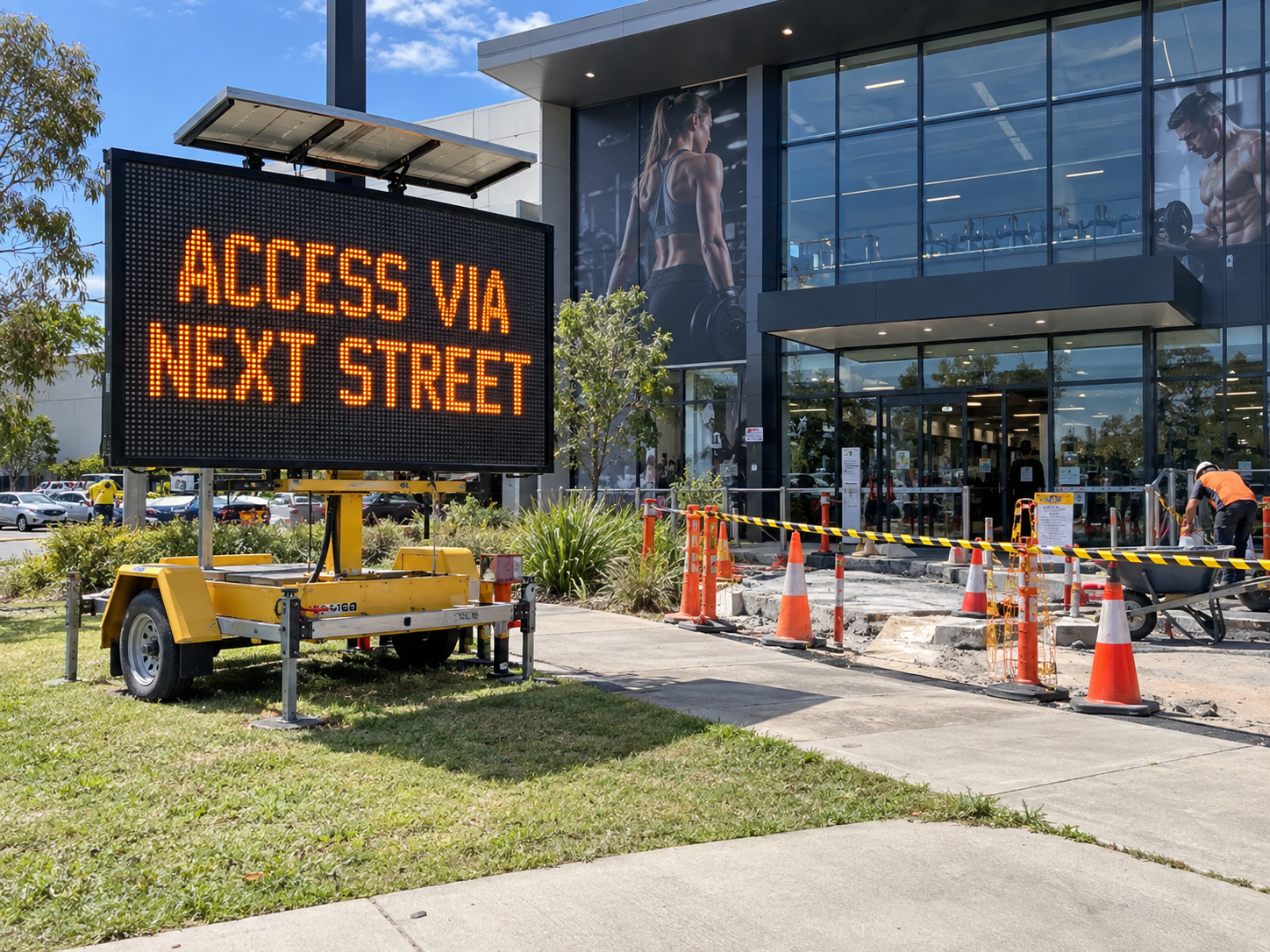
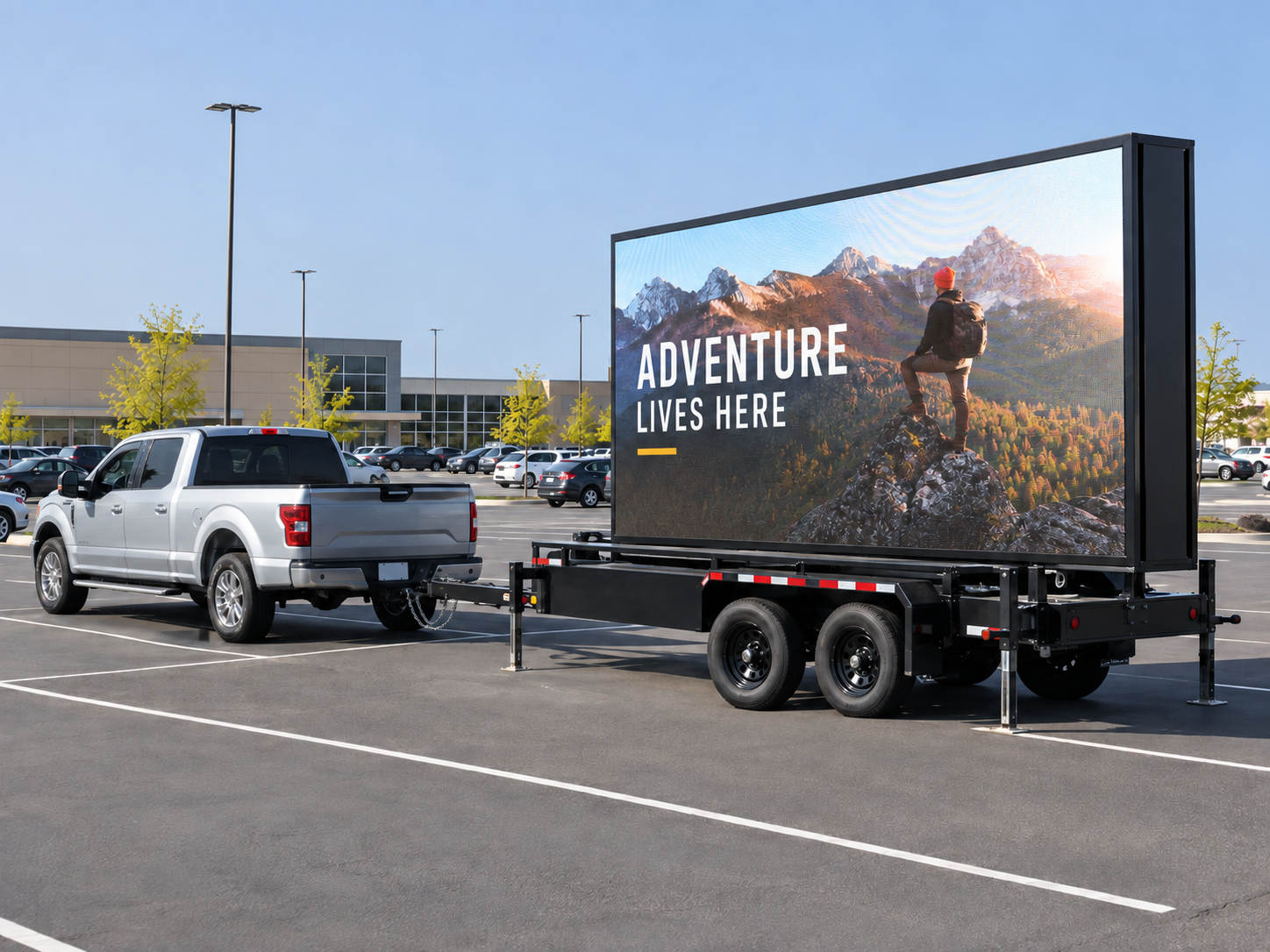
Signs of Success provides mobile LED advertising trailers for businesses across the Gold Coast and Brisbane. Its service includes delivery, positioning, setup, remote content updates and assistance with preparing content for the screen. The company’s trailers are promoted as solar-powered and supported by backup batteries, which can make them practical at undeveloped sites or temporary project locations where an external power connection is unavailable.
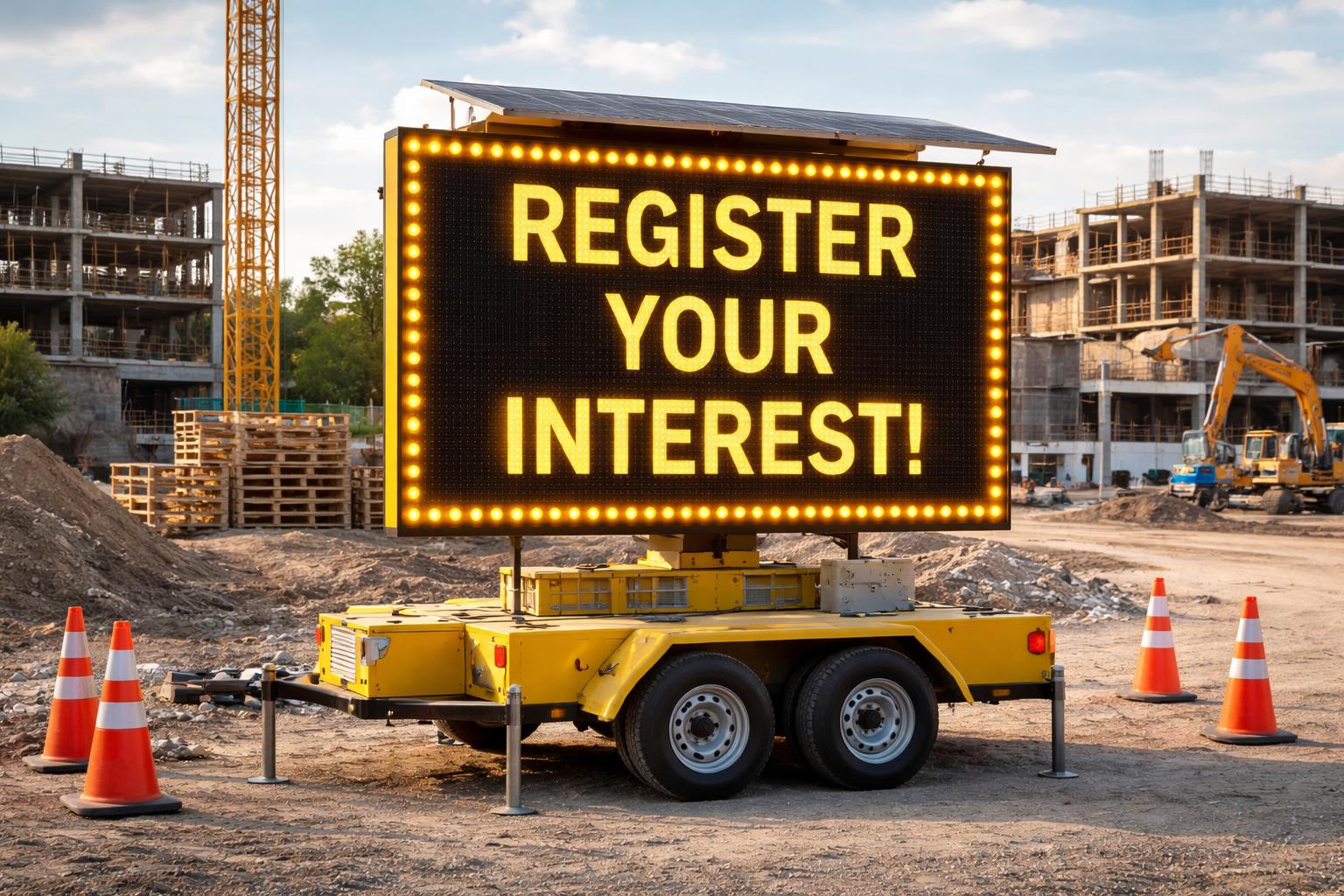
For a development team, however, the value is not simply that the screen is bright. The real advantage is the ability to use the same advertising platform throughout different stages of a project. A mobile digital billboard promoting “Register Your Interest” can later advertise “New Land Release”, “Display Homes Now Open”, “Inspection This Saturday” or “Final Townhouses Available”. Content can be changed without printing and installing an entirely new sign every time the campaign progresses.
A mobile screen must still be planned carefully. Placement, landowner permission, road visibility, council requirements, vehicle access, pedestrian movement and worksite safety all need to be considered. Promotional advertising must also remain clearly separate from official traffic-management signs, regulated public-notification signs and mandatory workplace safety controls.
This guide explains where a mobile LED billboard, portable LED billboard or mobile electronic billboard can add value across the property-development lifecycle, how to plan effective messages, what to consider before delivery and how Signs of Success can help make a project more visible without creating unnecessary work for the development team.
Why mobile electronic signs suit changing development projects
Property development involves long lead times, multiple stakeholders and frequent changes in campaign priorities. The marketing team may be promoting future lifestyle benefits while the construction team is managing deliveries, access and milestones. The sales team may need to advertise appointments one week and an open inspection the next. Project information can also change as stages sell, release dates move or new display homes become available.
Static signage still has an important role. Permanent estate identification signs, site fencing, sales-office branding, builder signs and statutory notices can provide continuity. Their limitation is that updating them normally requires redesign, production, transport and installation. That process may be inefficient when a message is relevant for only a few days or weeks.
Mobile electronic signs address a different need. They give project teams a temporary, flexible advertising channel that can be positioned for a specific campaign period and updated as circumstances change. Signs of Success states that its screens can be remotely programmed, allowing advertisements to be changed or scheduled for different times of day. It also offers content assistance, delivery, setup and collection as part of its service.
That flexibility is valuable because a development does not communicate with only one audience.
Prospective home buyers may need to know that a display village is open. Investors may be interested in apartment pre-sales or rental-demand information. Local residents may want details about a project information session. Tradespeople may respond to a contractor recruitment campaign. Agents, brokers and project partners may be invited to a launch event. Existing purchasers may need reminders about customer information evenings or milestone celebrations.
One digital billboard trailer can support these different objectives, but the content should not attempt to address every audience at once. The stronger approach is to identify the most important audience for each campaign period and build the screen message around the action that audience should take.
For example, a development approaching its first release could run:
NEW LAND RELEASE
REGISTER TODAY
Once appointments open, the same screen could change to:
SALES CENTRE OPEN
SATURDAY 10–4
During an industry event, it could become:
BROKER PREVIEW TODAY
ENTRY THIS WAY
This ability to align the message with the current stage of the project is more useful than displaying one generic statement for months. It also allows marketing activity to respond to sales results. If one product type sells quickly, it can be removed from the message. If a new stage is brought forward, the campaign can change accordingly.
Mobility is equally important. A fixed billboard remains attached to one place, whereas an LED trailer can be delivered to an appropriate approved site for a launch, weekend opening or short campaign. It may be positioned near a project sales office for one phase and at an authorised off-site event or promotional location for another, subject to the relevant permissions and advertising rules.
Signs of Success specifically identifies construction companies and property developers as a suitable customer group, suggesting its trailers can be used to announce developments, display project updates and direct visitors in a professional and visible way. The company serves Gold Coast and Brisbane clients and offers a growing fleet for campaigns that may need multiple screens or simultaneous locations.
For project marketers, that creates several strategic options. One sign can support a focused local launch. Multiple units can potentially cover different approved locations, such as the project entrance and a display village. A longer campaign can rotate messages by stage. A shorter campaign can concentrate visibility around a release weekend or sales event.
The technology is therefore not simply a larger version of a printed project sign. It is a responsive local advertising platform. Its purpose is to attract attention, communicate one timely idea and encourage the viewer to take the next step.
Where a mobile LED billboard can add value through the project lifecycle
The most effective campaign begins with a defined commercial or communication objective. A project team should know what it wants the audience to notice, understand and do before choosing the wording, location or campaign length.
A mobile screen can support many stages of construction and property development, but the creative direction should change with the objective.
New development launches
A project launch is often the first opportunity to turn broad awareness into identifiable demand. The campaign may be aimed at prospective purchasers, local agents, brokers, investors or nearby residents, depending on the development.
A mobile LED billboard can promote a formal launch event, sales-suite opening, preview weekend or registration campaign. Suitable messages include “New Coastal Residences”, “Project Launch This Saturday”, “Register for Priority Access” or “Sales Display Now Open”.
The screen should not try to reproduce the project brochure. Passing drivers and pedestrians do not have time to absorb a list of floor plans, inclusions and lifestyle features. The role of the billboard is to create recognition and prompt the next action. Detailed information belongs on the landing page, in the sales suite or in follow-up material.
Signs of Success can assist with formatting a client’s existing design or with basic content preparation intended to improve readability on the screen. Its service page says the team can advise on messaging, graphics and presentation for digital displays.
Land-release announcements
Masterplanned communities and residential estates often release land in stages. Each release may involve different lot sizes, outlooks, pricing bands or expected registration dates. Printed signs can become inaccurate as availability changes.
A mobile electronic billboard can highlight a new release for a defined period and then move to the next campaign message. Examples might include “Stage Four Now Selling”, “New Parkside Lots Released” or “Limited Homesites Available”.
The call to action should match the sales process. “Visit the Sales Centre” suits a location with staffed opening hours. “Register Online” is more suitable when the campaign is designed to collect enquiries outside those hours. “Book an Appointment” may be preferable for high-value or appointment-only projects.
Care is needed with claims about scarcity, prices, time limits and availability. Advertising should accurately reflect what purchasers can obtain. Australian advertising standards require marketing communications to be truthful and not misleading, while customer expectations can be shaped by the promises and claims made through advertising and signage.
Display village directions
Display villages can be difficult to find, particularly in new estates where roads, intersections and map data are still changing. A portable LED billboard positioned on an approved site near the village entrance can help confirm that visitors have reached the correct destination.
Useful messages include “Display Village Open”, “Builders’ Displays Ahead”, “Sales Centre Next Left” or “Open Today 10–5”. Directional arrows may be appropriate where the position and orientation of the screen make their meaning unambiguous.
The sign should not create confusion with official traffic signs. It should be positioned so that it does not obscure intersections, signals, road signs, pedestrian crossings or sightlines. The Queensland Department of Transport and Main Roads assesses roadside advertising according to road-safety and traffic-operation objectives, including the location, placement, design and operation of the advertising device.
It is also important to distinguish marketing directions from traffic control. “Display Village This Way” is promotional wayfinding. Instructions that control public-road traffic, alter speed, close a lane or direct vehicles through roadworks fall within a regulated temporary traffic-management system and should not be improvised on an advertising screen.
Apartment and townhouse pre-sales
Medium- and high-density developments often require sustained awareness before completion. A mobile campaign can be used during specific bursts of activity rather than displaying the same generic promotion throughout the entire construction period.
The screen could advertise the opening of a display suite, a new collection of residences, an appointment weekend or a final-release campaign. Potential messages include “Display Apartment Now Open”, “Townhomes Selling Now”, “Private Appointments This Weekend” or “Final Release Available”.
A common mistake is to show several property images, a full feature list, a logo, a price, a phone number, a web address and a disclaimer on one screen. That may satisfy internal stakeholders, but it weakens roadside comprehension.
A more effective rotation separates the information:
First frame: NEW TOWNHOMES
Second frame: DISPLAY OPEN SATURDAY
Third frame: BOOK YOUR TOUR
Whether multiple frames are appropriate depends on the location and relevant display rules. For signs visible from state-controlled roads, TMR’s roadside-advertising framework includes technical criteria designed to prevent distracting display behaviour. Campaign content and transitions therefore need to be planned for the actual site rather than assuming every animation or video format is permitted everywhere.
Construction milestones
Milestones can help maintain interest during a long delivery period. Commencement of construction, completion of major structural work, opening of a new road, display-home completion or the arrival of the first residents may all provide useful campaign moments.
A screen might display “Construction Now Underway”, “Display Homes Opening Soon”, “Stage Two Roads Complete” or “First Residents Moving In”. These messages can reinforce progress, especially where the public has seen construction fencing for months but may not otherwise know what has changed.
Milestone claims should be approved by the appropriate project representative before publication. The marketing team should establish who has authority to confirm dates and completion status, particularly when construction programs remain subject to weather, approvals, contractor availability or other variables.
Signs of Success can remotely update content, allowing an outdated date or milestone message to be replaced without producing another physical banner.
Project information sessions
Developers sometimes hold information evenings, purchaser updates, industry briefings or community drop-in sessions. A mobile digital billboard can promote the time and location to people already passing the site.
The message should make the nature of the event clear. “Community Information Session”, “Purchaser Update Evening” and “Project Launch Event” describe different activities and should not be used interchangeably.
The screen can also change as the event approaches:
A week before: INFORMATION SESSION THURSDAY
On the day: COMMUNITY SESSION TONIGHT
At the venue: SESSION ENTRY THIS WAY
This staged approach uses the screen as both a promotional reminder and on-site arrival aid.
It does not, however, replace any formal public-notification process required for a development application. Queensland’s development-assessment framework includes public notification as one of the possible formal stages of assessment, and the Development Assessment Rules govern how required notification is undertaken. The Queensland Government also provides templates specifically for public-notification signage.
Contractor recruitment
Construction programs can create demand for trades, labour, supervisors, machine operators, sales consultants and administrative staff. Where the target audience is likely to pass a project site or industry event, a mobile billboard can support recruitment.
Suitable messages might include “Local Trades Wanted”, “Now Hiring Site Supervisors”, “Civil Crews Required” or “Join Our Sales Team”. The call to action could direct candidates to a short employment landing page or invite them to enquire at a recruitment event.
Any QR code should be treated as secondary content, especially where the audience will mainly be driving. Drivers should never be encouraged to scan a code or record detailed information while moving. A short, memorable web address or employer name may be more suitable for roadside exposure, while a QR code may work well where pedestrians can stop safely.
Community consultation events
A development team may wish to invite residents to a voluntary consultation event, design workshop or project briefing. A mobile sign can raise local awareness when placed on an authorised site with suitable visibility.
The wording should avoid implying that an informal engagement event is a statutory process if it is not. “Meet the Project Team” or “Community Drop-In Session” may be clearer than formal planning language.
The project team should also ensure that the screen supports, rather than replaces, accessible communication. Website information, direct correspondence, printed material and contact options may still be needed for people who do not pass the sign or cannot attend the event.
Temporary access changes
A development may need to tell sales visitors that the display suite has moved, that an entrance is temporarily closed or that inspections now begin at another location. A digital screen can communicate these changes quickly.
Examples include “Sales Office Entry via Green Street”, “Display Parking Relocated”, “Visitor Entry Next Driveway” or “Sales Suite Closed Monday”.
This use needs particularly careful planning because access messages can affect vehicle and pedestrian decisions. The screen should not conflict with the construction site’s traffic-management plan, emergency access arrangements, delivery routes or official traffic-control devices.
Workplace Health and Safety Queensland says risks must be managed where vehicles and powered mobile plant operate in the same area as pedestrians. Its guidance recommends designated pedestrian routes, driver directions, exclusion zones, signs and road markings, with physical separation used where possible.
A promotional trailer should therefore be placed outside operational conflict areas. It should not narrow a walkway, occupy a loading area, obstruct a gate or encourage members of the public to enter a work zone.
Opening dates and inspection events
Display-home openings, sales-suite launches and project inspections are well suited to short-duration advertising because the message is time-sensitive.
A campaign can begin with “Opening This Weekend”, change to “Grand Opening Tomorrow” and then display “Now Open” during the event. If opening hours differ by day, remote scheduling can help present the correct message at the correct time.
Signs of Success says its platform can schedule rotating advertisements at different times of day. That could allow a development to display “Open Today 10–4” during staffed hours and “Book a Private Appointment” after the sales centre closes.
Sales office promotions
Not every project campaign needs to announce a major release. Sometimes the priority is simply to generate more qualified visits to the sales office.
A sign can advertise weekend hours, extended trading, new displays, consultation appointments or purchaser incentives. Messages such as “Sales Centre Open Today”, “Walk-Ins Welcome” or “Book a Site Tour” are direct and easy to understand.
The best message depends on what the team can deliver. “Walk-Ins Welcome” should not run when the office is unstaffed. “Inspect Today” should not be used if access requires a prior booking. Keeping operational details aligned with advertising protects the customer experience.
Planning a portable LED billboard campaign that stays current
The technology can change the advertisement quickly, but that does not remove the need for a content plan. In fact, flexible screens work best when the project team decides in advance how the campaign will respond to dates, availability and sales stages.
Begin with one primary objective. It might be registrations, display-village visits, inspection bookings, event attendance, employment enquiries or general awareness. Trying to optimise one screen for every objective usually produces crowded creative and a weak call to action.
Next, define the audience. A first-home buyer, downsizer, investor, local resident and subcontractor will respond to different language. “House and Land Now Selling” may suit buyers, while “Civil Contractors Wanted” belongs in a separate recruitment rotation or campaign period.
The location should influence the amount of content. A person walking into a display village has more time to read than a motorist passing a project frontage. Roadside content should be brief, with a strong hierarchy and enough contrast to be understood quickly.
A practical structure is:
What is it?
New land release.
Why does it matter now?
Registrations are open.
What should the viewer do?
Visit the sales centre.
That might become three short frames or one concise screen, depending on the display configuration and site requirements.
Project teams should also establish a content-approval process. One person should be responsible for sending changes to Signs of Success, and another may need to confirm commercial claims, dates or legal wording. Without clear responsibility, an obsolete offer can remain live because everyone assumes someone else requested the update.
A simple content schedule can identify:
- the message to run before an event;
- the message to run on the day;
- the message to run after the event;
- what should replace a sold-out or postponed offer;
- who can authorise each change.
For a land-release weekend, the sequence might begin with “New Release This Saturday”, change to “Land Release Today” and then move to “Appointments Available” after the event. For a display-home launch, it might progress from “Opening Soon” to “Grand Opening Weekend” and finally “Now Open Daily”.
Signs of Success can assist with remote updates and time-based rotations, but the client still needs to supply accurate instructions and approve the campaign content.
Different dayparts may also support different messages. Morning traffic may respond to “Display Village Open Today”. Afternoon traffic could see “Visit Before 5pm”. Evening content might invite people to “Book a Weekend Tour”. This is most useful when each message reflects a real service or opening time, rather than changing merely for visual variety.
Brand consistency matters, but the billboard should not be treated like a reduced website homepage. A project logo, recognisable typography and one hero image may be enough. Fine-print detail can be provided elsewhere, subject to any disclosure requirements relevant to the offer.
The screen should also be updated when circumstances change. If wet weather postpones a launch, the date should not remain displayed. If a stage sells out, the campaign should move to the next appropriate call to action. If the sales office closes unexpectedly, the screen can direct customers to online enquiries rather than inviting them to an unattended site.
This is where a mobile platform can be particularly useful during construction. The development itself is changing, and the advertising can change with it.
Positioning a digital billboard trailer safely and lawfully
A successful site is not merely the closest available patch of ground to the road. The trailer needs sufficient access, a stable position, suitable visibility and the appropriate permissions. It must also avoid interfering with construction activities, road users, pedestrians, neighbours and emergency arrangements.
Before booking, the project team should identify exactly where it wants the digital billboard trailer positioned. Useful information includes a marked site plan, photographs from approaching traffic directions, proposed screen orientation, ground conditions, access-gate dimensions and any restrictions on delivery times.
Private property is often the most practical option, but landowner or authorised occupier consent is still important. In Brisbane, Council’s advertising-device application process requires landowner consent when the applicant is not the owner. Supporting information may include accurate site plans and details of the device’s design and construction.
Advertising controls vary by location and device type. Brisbane City Council identifies some high-impact electronic signs and standing vehicle signs as prohibited in certain circumstances or locations, while other advertising devices require assessment according to the property zone, environment classification and proposed sign type.
The City of Gold Coast states that an advertising sign visible from a public place may require a licence, although its current guidance says it does not licence advertising signs displayed on a parked vehicle or trailer. That does not necessarily remove other responsibilities involving property permission, lawful parking, development conditions, road-corridor controls or safe placement. The City recommends supplying location plans, dimensions, support details and illumination information where an application is required.
Where the screen will be in, adjacent to or visible from a state-controlled road corridor, TMR requirements may also become relevant. Its Roadside Advertising Manual is intended to help assess advertising proposals against road-safety and traffic-efficiency objectives. The department says approval frameworks consider the sign’s location, placement, design and operation, including whether it could distract drivers or affect safety.
Approvals should therefore be investigated early rather than after the trailer arrives. Signs of Success can discuss practical placement and delivery requirements, but formal advice and permission may need to come from the relevant council, TMR, landowner, principal contractor or site manager.
Physical conditions are just as important.
The ground should be capable of supporting the trailer and its stabilisation system. Soft, recently disturbed or waterlogged ground may be unsuitable. Sloping sites require careful assessment. Overhead services, trees, fencing, temporary structures and excavation areas can limit both access and screen visibility.
Delivery access should be separated from busy public periods wherever practicable. If the trailer must pass through an active construction entrance, the movement should be coordinated with the site’s authorised traffic-management and safety arrangements. The site contact should know when delivery and collection will occur, where the towing vehicle may turn and whether an escort or gate access is required.
The final position should not obstruct:
- construction or emergency gates;
- pedestrian paths;
- accessible parking or access;
- vehicle sightlines;
- loading and unloading areas;
- fire-service access;
- site offices or amenities;
- official safety signs;
- traffic-control devices;
- underground or overhead infrastructure.
WorkSafe Queensland emphasises that vehicles, mobile plant and pedestrians must be managed to reduce collision risk. Its guidance supports separate routes, designated walkways, exclusion zones, barriers, site instructions and clear signage.
The advertising trailer should sit outside these operational controls rather than becoming another obstacle within them.
Screen orientation also requires thought. The best angle is the one that gives the intended audience a clear, safe view without creating glare, visual conflict or an obstruction. It may not be the angle that faces the greatest total number of vehicles. Quality of exposure matters more than raw traffic if many viewers cannot safely read the message or are not prospective customers.
Night operation should be discussed in advance. Nearby residents, accommodation, intersections and road conditions may influence appropriate operating hours and brightness. The relevant approval may impose conditions, and content that is acceptable at a daytime event may be unsuitable for continuous night display.
Trailer roadworthiness matters during delivery and collection. Queensland requires the towing vehicle and trailer to be registered and roadworthy and requires the trailer’s rear number plate to be illuminated and unobscured.
Searches such as led trailer lights, trailers lights and led lights trailer lights usually relate to the trailer’s roadgoing lamps, indicators, reflectors and visibility rather than the advertising screen itself. These components should be distinguished from the LED display. A professional hire arrangement reduces the need for the development client to source, maintain, register and tow the equipment independently.
Signs of Success says it manages delivery, setup, support and removal, allowing the client to focus on the campaign rather than trailer logistics.
Why promotional advertising cannot replace official site and traffic signage
A bright digital screen can communicate a project message, but it should never be treated as a substitute for regulated traffic-management devices, mandatory safety signs, statutory development notices or emergency information.
This distinction is essential on a construction or civil project.
A promotional message is designed to market, inform or invite. Examples include:
NEW HOMES NOW SELLING
DISPLAY VILLAGE OPEN
PROJECT INFORMATION NIGHT
SALES CENTRE THIS WAY
Traffic-management and safety signs have a different function. They may regulate movement, warn of hazards, identify exclusion zones, provide site instructions or direct road users through temporary works. Their design, positioning, authorisation and use may be governed by legislation, approved manuals, traffic-guidance schemes and the site’s risk controls.
TMR states that the Queensland Manual of Uniform Traffic Control Devices governs signs, lines, lights and other devices used to manage traffic on the state-controlled road network and on private roads open to public travel. Its Q-series and traffic-control signs are officially approved for specific uses under Queensland road legislation.
It follows that a marketing team cannot simply display “STOP”, “ROAD CLOSED”, “REDUCE SPEED” or a similar traffic-control instruction on a promotional mobile electronic billboard and assume that it performs the role of an official device. Temporary traffic management must be planned and implemented through the appropriate authorised process.
The same applies inside a worksite. WorkSafe Queensland says signage should identify walkways, guide traffic, provide warnings and mark exclusion zones. It also notes that physical barriers can be more effective than lightweight visual markers because barriers physically prevent access.
A mobile advertising screen should not replace these controls. It should not be the only warning that mobile plant is operating, the only indication of an exclusion zone or the only direction separating pedestrians from heavy vehicles.
The safest operational principle is straightforward: treat the mobile LED sign as a marketing asset located outside controlled work activities. Keep official safety and traffic-management information within the project’s authorised systems.
There is a similar distinction for development-assessment notification. Some development applications are subject to formal public notification under Queensland’s development-assessment process. The Development Assessment Rules specify how required public notification is undertaken, and the Queensland Government provides dedicated signage templates.
A developer may use a mobile screen to promote an additional community information event, but it should not assume that doing so satisfies a statutory notification obligation. The project planner or legal adviser should confirm the exact requirements for the application.
Promotional information should also avoid creating unsafe behaviour. A screen should not encourage a driver to make an abrupt turn, enter a closed gate or stop in an unsuitable location. Directions need to reflect the actual, authorised public entrance. If access changes, both the advertising and operational site controls should be updated through their respective processes.
This separation protects everyone involved. The principal contractor retains control of worksite safety. Qualified traffic-management personnel retain control of official devices. Planning professionals manage statutory notification. The marketing team uses the LED trailer to build awareness and guide customers only where doing so is safe, accurate and authorised.
Signs of Success can help make a development message more visible, but the campaign should always be integrated with the site’s broader planning rather than operating independently of it.
Hiring or buying an LED trailer for a development campaign
Some developers begin their research with phrases such as mobile digital billboards for sale, mobile LED billboard for sale or mobile LED signs for sale. Ownership may appear attractive to an organisation with a long project pipeline, but the purchase price is only one part of the decision.
An owned trailer requires storage, registration, towing capability, insurance decisions, maintenance, battery management, screen servicing, software administration, content scheduling and internal responsibility for every delivery and collection. The owner also needs to confirm that each deployment complies with property, road and advertising requirements.
Hiring can be more suitable when visibility is needed in concentrated periods: a launch month, a land-release weekend, an inspection campaign or the opening of a display village.
A project team that chooses to rent LED trailer equipment can match the hire period to a particular sales stage without retaining the asset between campaigns. It can also test how the medium performs at one development before considering broader use across its portfolio.
Signs of Success provides a full-service model rather than handing over a basic trailer for the client to manage. Its stated service includes transport, positioning, setup, remote programming, content assistance, support during the rental and collection after the campaign.
That can be particularly useful for a developer whose staff are already managing launch events, agents, builders, creative agencies, purchasers and site operations. The team can brief Signs of Success on the commercial objective, approved location, campaign dates and content, while the provider handles the advertising equipment.
Before booking, the developer should provide:
The project and business details. Explain whether the campaign relates to residential land, apartments, townhouses, commercial premises, a display village, civil works or another development type.
The campaign objective. State whether the priority is awareness, registrations, appointments, event attendance, display visits, recruitment or community information.
The proposed dates and operating hours. Include delivery and collection preferences as well as the hours during which the screen should operate.
The exact location. Supply the site address, preferred position, photographs, map pin and any access instructions.
Permission and approval status. Confirm who owns or controls the proposed site and whether council, TMR, body corporate, shopping-centre, venue or other approval has been considered.
Site conditions. Describe the ground surface, slope, access width, gates, overhead restrictions, pedestrian activity and nearby construction operations.
The intended audience and viewing direction. Explain whether viewers will be driving, walking, entering a sales centre or attending an event.
The campaign content. Provide the logo, brand guidelines, approved images, headline, offer, dates, call to action and any required disclaimers.
The update plan. Identify whether the message needs to change before, during or after the event and who may authorise those changes.
People often enter an awkward search phrase such as hire mobile LED sign when they are ready to compare providers. At that stage, the most useful question is not merely “How much is the trailer?” It is “What support is included, and what does our team still need to organise?”
The answer should cover delivery, setup, site access, content preparation, remote changes, operating time, collection and responsibilities for permissions. A low equipment-only price may not represent good value if the client must arrange towing, positioning, power and technical support separately.
Signs of Success can discuss the needs of a one-day launch, a weekend campaign, a multi-week sales push or a recurring development schedule and recommend a practical hire approach based on the actual project.
Make your next development impossible to miss with Signs of Success
A construction or property project may take years to deliver, but customer attention is often won in short moments. Someone drives past a new estate. A local family notices that display homes are open. An investor sees that appointments are available. A tradesperson learns that the project is recruiting. A resident is reminded about an upcoming information session.
A well-planned mobile LED sign turns those moments into opportunities.
Signs of Success can help Gold Coast and Brisbane builders, property developers, civil contractors, project marketers and display village operators create timely, visible campaigns for launches, land releases, sales-office promotions, inspection events, project updates and approved visitor directions.
Its solar-powered advertising trailers are designed for flexible placement without reliance on external power, while remote content management allows messages to be updated as opening times, release stages, milestones and availability change. Delivery, setup, content assistance, support and collection are available as part of the service.
Whether you call it a mobile digital billboard, mobile LED billboard, portable LED billboard, digital billboard trailer, mobile electronic billboard or LED trailer, the objective is the same: put a clear, relevant message where the right people can see it.
The strongest campaigns begin early. Confirm the objective, audience, dates, approved location, access conditions and content-update schedule before delivery. Keep the advertisement separate from statutory, traffic-management and workplace-safety signage. Use short messages, accurate calls to action and content that reflects the project’s current stage.
Contact Signs of Success for more information and assistance with mobile LED sign hire across the Gold Coast and Brisbane. The team can help you plan the campaign, prepare screen-ready content, coordinate delivery and keep your message current from the first project announcement to the final sales push.