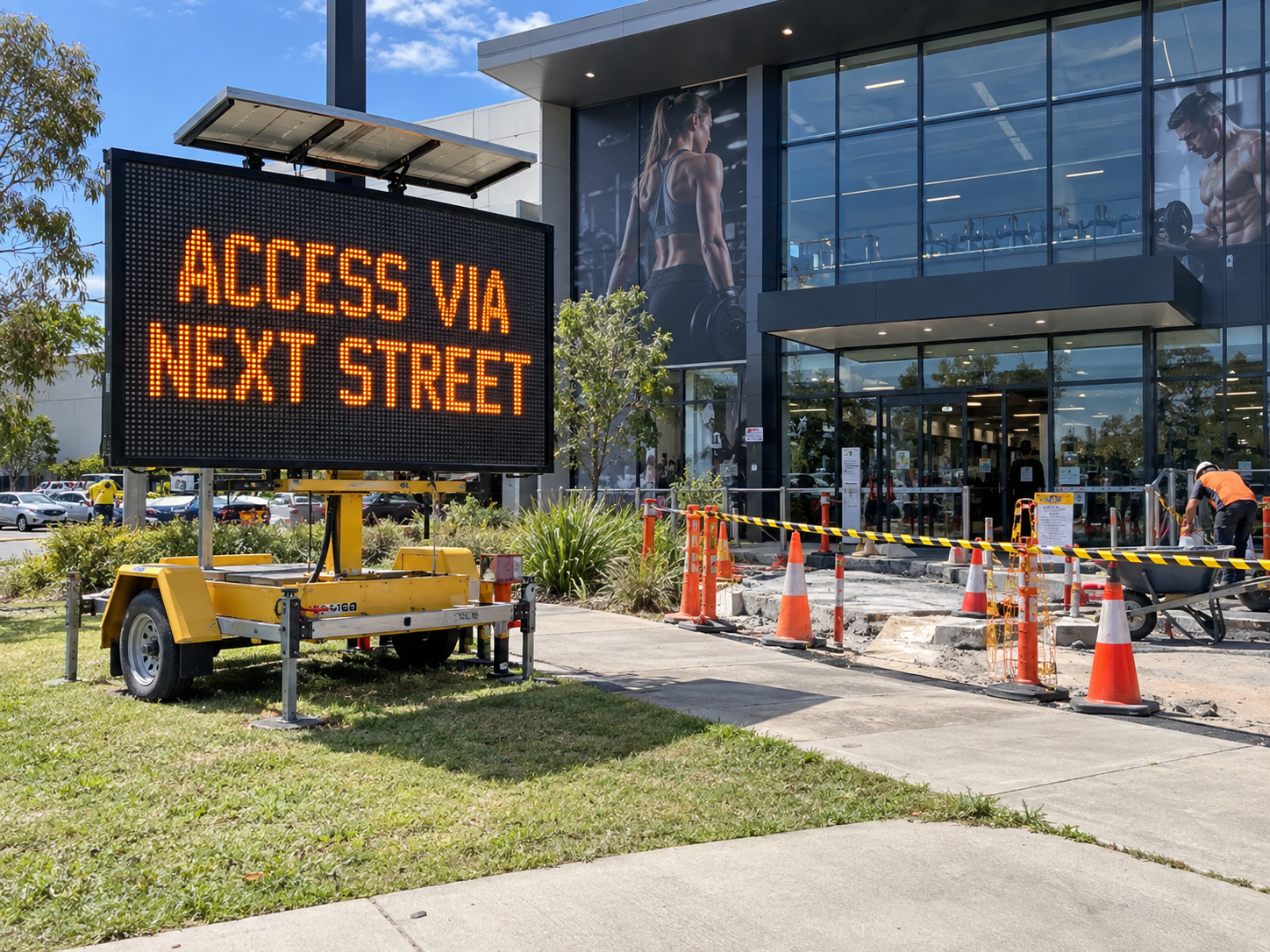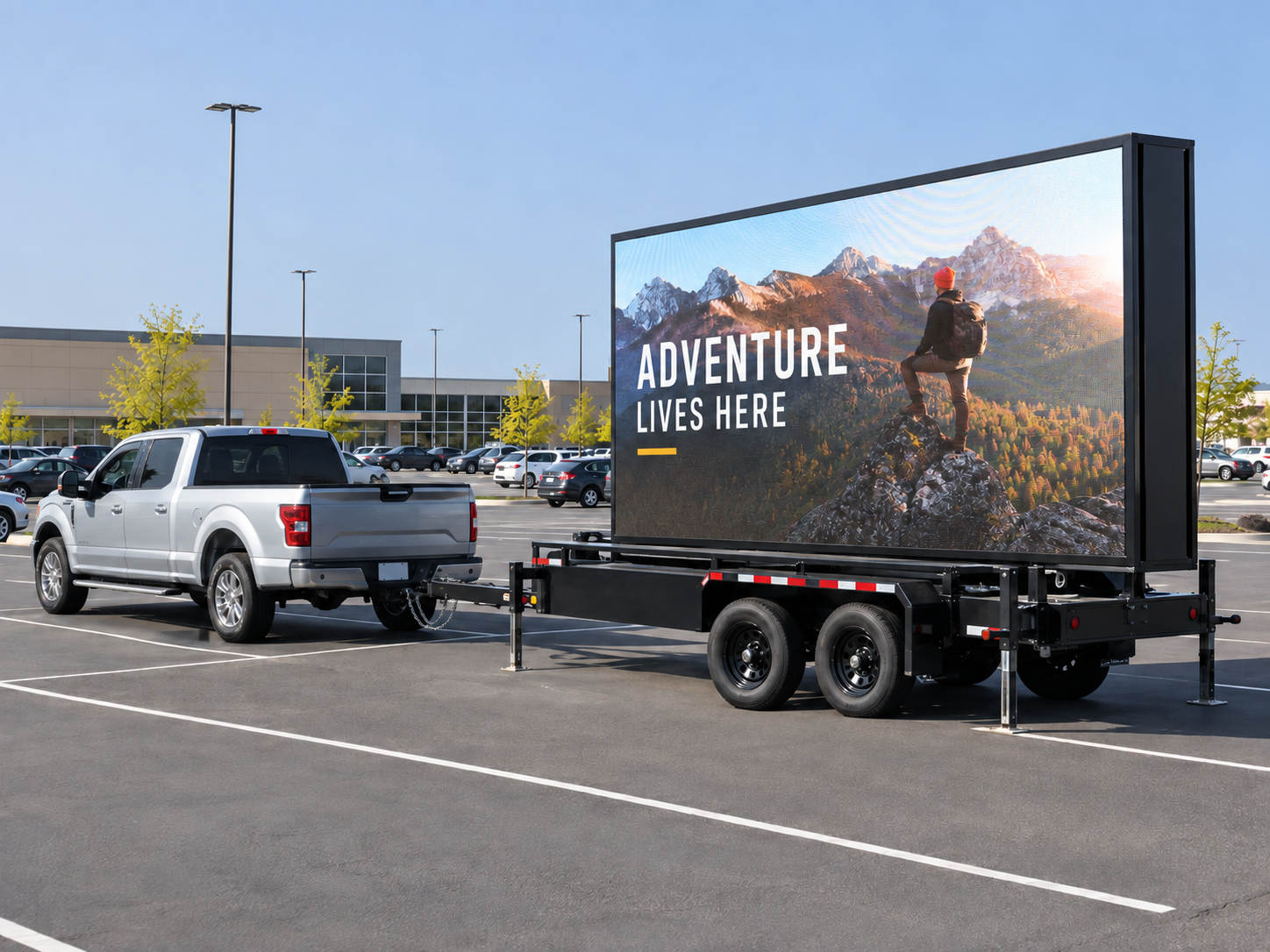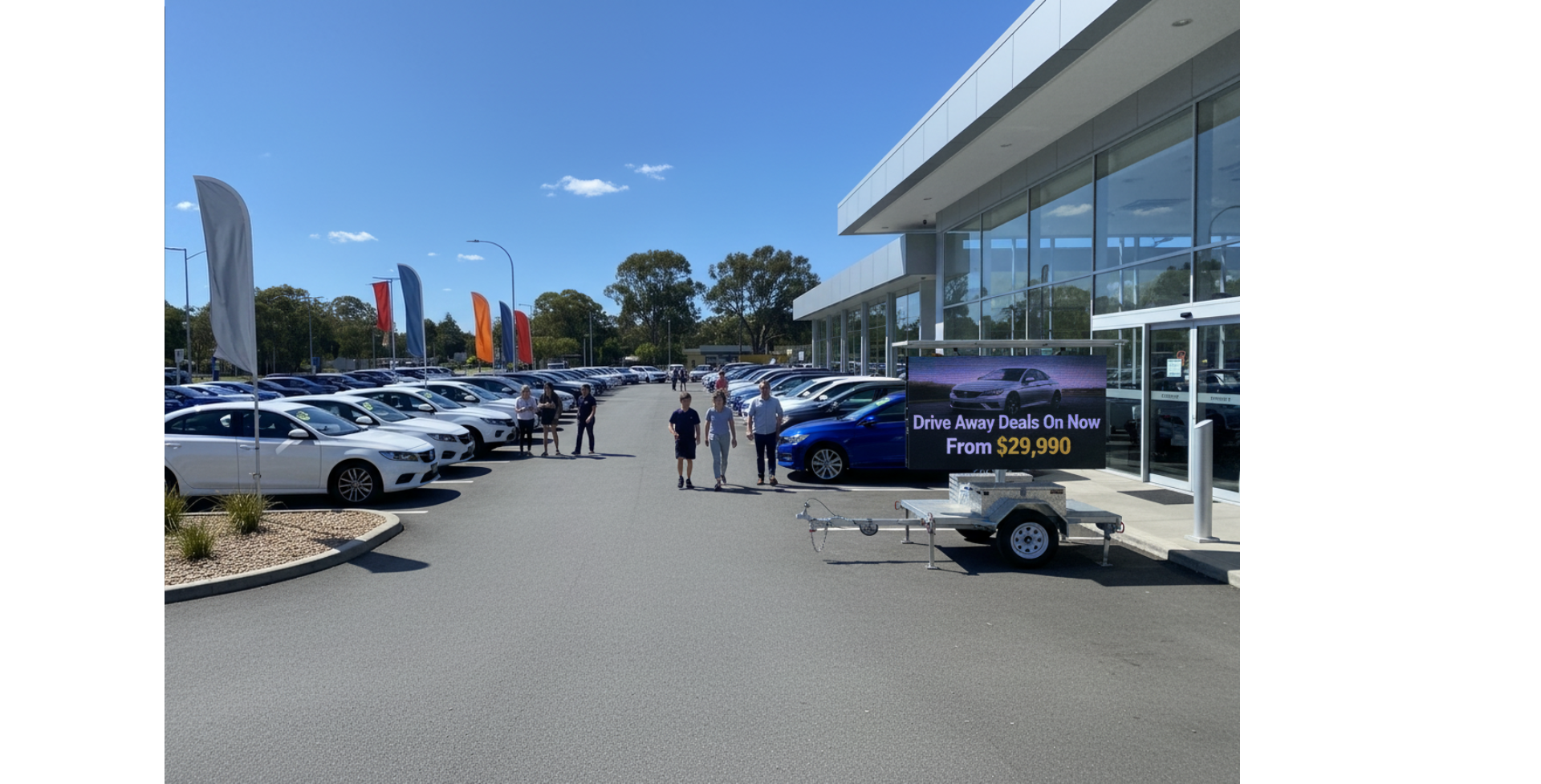
Car dealerships compete in one of the most visually crowded retail environments. Rows of vehicles, manufacturer flags, window stickers, fence banners and permanent dealership signage may all be competing for the attention of people travelling past at speed. Even when a dealership has strong stock, competitive finance options or a worthwhile sales event, the promotion can disappear into the surrounding visual noise.
A professionally positioned mobile LED sign gives dealerships another way to bring their most important message to the front of the property. Instead of relying only on permanent signage or expecting prospective buyers to discover an offer online, a bright digital display can place timely information directly in the sightline of passing motorists, local workers, nearby residents and people already visiting the automotive precinct.
For a new-vehicle dealership, that message might be an upcoming model launch. For a used-car yard, it could be newly arrived stock or a clearance weekend. A truck dealer might advertise fleet vehicles, while a motorcycle dealership could promote a ride day, new model release or seasonal servicing offer. Automotive service centres can use the same format to promote logbook servicing, tyre offers, air-conditioning checks or technician vacancies.
Signs of Success provides mobile LED advertising trailers for businesses across the Gold Coast and Brisbane, with delivery, setup and campaign support designed to make the process straightforward. The company’s service is built around flexible campaigns that can run for a few days, a week or longer, with content that can be changed as the promotion develops. Signs of Success already identifies car dealerships as a key use case for displaying stock and offers, making a dealership-specific campaign a natural fit for the service.
A mobile digital billboard is not intended to replace every part of a dealership’s marketing. Its strength is its ability to connect roadside visibility with the broader sales campaign. The dealership can use online listings, paid search, social media, manufacturer advertising, email and database marketing to reach people digitally, while an LED trailer reinforces the promotion at the physical location where the vehicles can actually be inspected and test-driven.
The result is a practical bridge between awareness and action. A person may first see “Test-Drive Weekend” while passing the dealership, notice the same offer later on social media, then return when they are ready to compare vehicles. Another buyer may already be researching a model online but need a clear roadside prompt to realise that a nearby dealership has demonstrator stock available.
The most effective campaigns do not attempt to display the entire sales catalogue on one screen. They identify the strongest reason for someone to look, remember the dealership and take the next step.
Why a Mobile LED Billboard Suits Automotive Marketing
Vehicle sales are naturally visual. Buyers want to see the model, body shape, colour, interior, price range and key offer. A mobile LED billboard can combine a clear photograph or graphic with a short message that can be understood quickly.
Unlike a static banner that must remain unchanged until it is physically replaced, a digital display can support different stages of the same campaign. A dealership could begin with “New Model Arriving Soon”, change to “Launch This Saturday”, then switch to “Test Drives Available Today”. Used-car stock can be updated as featured vehicles sell. A service department can replace a weekday booking message with a Saturday inspection or tyre promotion.
Signs of Success promotes flexible digital displays that can show images, video, slideshows and dynamic content. Its service includes delivery, setup and support, allowing the dealership team to concentrate on leads, vehicle preparation and customer appointments rather than the logistics of operating the advertising equipment.
That flexibility is especially useful because dealership promotions often change quickly. Stock availability, demonstrator numbers, model-year campaigns, manufacturer incentives and event dates can all move during the advertising period. A printed roadside banner may become outdated, but a managed digital billboard trailer can be refreshed when the campaign circumstances change.
The mobility of the equipment is equally important. A portable LED billboard can be positioned near the dealership’s most visible frontage, subject to access, landowner permission, local rules and road-safety considerations. It can also be used for an off-site activation, shopping-centre display, community event, trade show, fleet demonstration or dealership group campaign.
Signs of Success can help dealerships consider the message, duration and positioning before deployment. Its Gold Coast roots and focus on local business visibility are relevant in an industry where the best placement often depends on the shape of the site, the direction of traffic, nearby intersections and the way customers enter the property. The company describes its role as an advertising partner rather than simply an equipment supplier, with personalised campaign support and local experience.
A mobile sign can also give smaller dealerships a way to create the sense of occasion normally associated with larger manufacturer campaigns. An independent used-car dealer may not have a national advertising budget, but it can still make a weekend sale feel prominent at street level. A motorcycle dealership can build excitement around a new model reveal. A truck or commercial-vehicle dealer can direct local tradespeople and fleet buyers to a specific offer.
The format is particularly well suited to time-sensitive messages such as:
“EOFY Clearance Now On”
“New Model Launch Saturday”
“Fresh Used Stock Just Arrived”
“Test Drives Available Today”
“Trade-In Event This Weekend”
“Technicians Wanted — Apply Inside”
Each example has one job. It tells the viewer what is happening and gives them a reason to respond. That simplicity is essential because roadside audiences do not read advertising in the same way they read a website or brochure.
Queensland’s Roadside Advertising Manual says advertising devices visible from state-controlled roads should be quickly and easily interpreted, should not be overly bright and should not imitate official traffic signs. It also identifies size, location, luminance and changing content as factors that can affect traffic safety.
For dealerships, the practical implication is clear: the aim is high visibility, not maximum complexity. A bold, relevant message is more useful than a crowded screen containing multiple models, several prices, long disclaimers, a web address, phone number, dealership slogan and five separate calls to action.
Campaign Ideas for Stock, Sales and Dealership Events
A successful dealership campaign begins with a commercial objective. “We want more attention” is a reasonable starting point, but the creative becomes stronger when the dealership defines what it wants people to do with that attention.
The objective might be to increase showroom visits, generate test-drive bookings, move ageing stock, promote a new model, attract trade-ins, fill service appointments or recruit qualified staff. Signs of Success can help turn that objective into a focused display sequence rather than a generic dealership advertisement.
EOFY and end-of-month sales
End-of-financial-year and end-of-month periods can create a natural reason for dealerships to intensify promotional activity. The display does not need to make exaggerated claims. It can simply communicate that a defined sales event is happening now.
Useful directions include “EOFY Sale Ends Sunday”, “End-of-Month Demonstrator Event”, “Selected Stock Available Now” or “Visit Today for Current Offers”. The dealership can rotate a general event slide with one or two representative vehicle categories, such as SUVs, utes or used vehicles under a particular threshold.
Where pricing appears, the dealership should ensure that the advertised figures and vehicle details are accurate and that the overall impression is not misleading. The ACCC’s motor-vehicle pricing guidance says advertisements for new, used and demonstrator vehicles must comply with the Australian Consumer Law. It explains that where a component price is promoted, a prominent single total price must also be provided to the extent that it can be quantified.
That makes restraint especially important on a roadside display. A dealership may decide that a simple event message is more suitable for the mobile electronic billboard, while detailed pricing and conditions are presented on a properly constructed landing page or within the showroom. However, a landing page or QR code cannot be used to repair a headline that is misleading on its own. Both the ACCC and ASIC emphasise that qualifications must be prominent enough for the medium and that fine print should not contradict the main message.
Newly arrived vehicles
A “new stock” campaign works well when the dealership has received vehicles that match current local demand. A used-car yard might promote “Fresh Used SUVs Just Arrived”, while a commercial dealer could feature “New Utes and Vans Available”.
The first slide should communicate the category rather than attempt to list every unit. Subsequent slides can highlight selected vehicles, but the campaign should be updated when those vehicles are sold or no longer available.
This is one of the key advantages of a Signs of Success campaign. The screen content can be refreshed rather than leaving an outdated vehicle in the rotation. If the featured vehicle sells, the dealership can replace it with another unit, change the slide to “More Stock Available” or move attention to the next promotion.
Dealership staff should establish a simple content-update process before the campaign begins. One person should be responsible for confirming stock status, pricing and approval. The sales manager, dealer principal or marketing manager can then provide Signs of Success with authorised changes.
Demonstrator clearances
Demonstrators can be attractive to buyers because they may offer a combination of current-model features and reduced pricing, but the message still needs to remain clear. A roadside campaign might lead with “Demonstrator Clearance”, followed by a representative model and a direct invitation such as “Inspect Today”.
Avoid filling every slide with kilometres travelled, accessory lists, registration details and multiple conditional prices. Those details belong on the landing page or vehicle listing. The roadside display should establish the category and motivate the next step.
Where a specific demonstrator is pictured, the photograph, model description, visible accessories and advertised price should correspond with what is genuinely available. ACCC guidance cautions that pictorial motor-vehicle advertising should accurately match the vehicle and offer being promoted.
Used-car stock campaigns
Used-car campaigns often benefit from category-led messages. Examples include “Quality Used Utes”, “Family SUVs Available”, “Automatic Hatchbacks in Stock” or “Trade-Ins Arriving Daily”.
This approach reduces the risk of building the entire campaign around one unit. If the dealership does feature a specific car, it should remove or replace that slide promptly when the car sells. The ACCC prohibits bait advertising where a vehicle is promoted at an attractive price when the dealer knows, or should know, that it cannot be supplied in reasonable quantities for a reasonable period. For used vehicles, its guidance recommends stating how many vehicles of the promoted type are available.
A well-managed mobile led sign campaign should therefore remain closely connected to the dealership’s live stock-management process. Signs of Success can assist with display updates, but the dealership must provide current and approved information.
Finance promotions
Finance can be a strong response driver, but it is also an area where the shortest wording can carry the greatest compliance risk. Weekly repayment amounts, low-rate offers, balloon payments, deposits, eligibility conditions and loan terms may all materially affect the offer.
ASIC’s current advertising guidance says qualifications must be prominent and understandable on first viewing. It also says that directing a consumer to another page or QR code is not enough to correct a misleading headline. ASIC specifically warns that a motor dealer should not present a lease as though it were finance appropriate for someone seeking to purchase the vehicle.
ASIC also notes that outdoor advertising may be better suited to brand or product recognition than to complex product information. Where financial products or services are promoted outdoors, warnings, qualifications and disclaimers need to be sufficiently prominent for the environment and the limited time in which the advertisement will be seen.
For that reason, a message such as “Ask About Available Finance Options” may sometimes be more suitable than placing a highly conditional weekly repayment claim on the trailer. Dealerships should have all finance creative checked by their compliance team, finance provider or legal adviser before sending it to Signs of Success for display.
Test-drive weekends
A test-drive event is one of the clearest uses for an LED campaign because it has a specific action, location and deadline. A dealership can begin promoting the event several days in advance, increase urgency as the weekend approaches and display “Test Drives Today” once it begins.
The campaign sequence could move from awareness to action:
“New SUV Test-Drive Weekend”
“This Saturday and Sunday”
“Bookings Available”
“Turn In Today”
A QR code can support bookings when the sign is viewed by pedestrians, passengers or people already stopped safely within the dealership. For general passing traffic, a memorable dealership name, short phone number or simple “Book Online” instruction is usually easier to process.
Signs of Success can help schedule different stages of the message, so the display remains relevant before, during and near the end of the event.
New model launches
A new model launch benefits from anticipation. The first phase can tease the arrival, the second can announce the date, and the third can invite immediate inspection or test drives.
A dealership might use “Coming Soon”, followed by the model silhouette or approved manufacturer creative. Later slides can say “See It This Saturday” and “Now in Showroom”.
A digital billboard trailer placed near the dealership frontage can help make the launch visible beyond existing customers who already follow the dealership online. It can also reinforce manufacturer advertising by connecting the model to the local retailer where enquiries and demonstrations occur.
All manufacturer logos, imagery, model descriptions and campaign claims should follow the relevant brand guidelines and approval process. Signs of Success can help adapt approved material for the screen format without attempting to compress a full brochure into the display.
Trade-in events
Trade-in campaigns work best when the proposition is easy to understand. “Trade-In Appraisals This Weekend”, “Thinking of Selling Your Car?” or “Upgrade Event Now On” can encourage owners to begin a conversation.
Claims such as “highest price”, “guaranteed value” or “any trade accepted” should not be used casually. The dealership should be able to substantiate the claim and disclose material limitations clearly.
A mobile campaign can direct prospects to an appraisal form, a campaign phone number or the dealership entrance. It can also be coordinated with an email campaign encouraging existing customers to bring their current vehicle back for valuation.
Service department promotions
Dealership marketing should not stop at vehicle sales. Service departments, parts counters and tyre centres provide repeat-revenue opportunities and may appeal to an existing customer base that is not currently shopping for a new vehicle.
Useful campaign messages include “Service Bookings Available”, “Saturday Servicing”, “Air-Con Check”, “Tyre Offers”, “Genuine Parts Enquiries” and “Book Your Logbook Service”.
Seasonal relevance matters. Air-conditioning and cooling-system promotions may be timely before a Queensland summer, while tyre, battery and safety checks can support holiday-travel periods. The display can also change by time of day, promoting service bookings during the morning and vehicle sales during the afternoon.
Recruitment for technicians and sales staff
Automotive employers can also use mobile electronic signs to reach local workers. A trailer positioned at the dealership may be seen by technicians, apprentices, detailers, service advisers and salespeople already travelling through the automotive precinct.
The message should identify the role clearly: “Qualified Technicians Wanted”, “Apprentice Mechanic Applications Open” or “Sales Consultant Opportunities”.
A short application URL or QR code can lead to a dedicated job page. The dealership can measure submissions separately from recruitment platforms, helping it understand whether the roadside campaign generated interest.
Designing Roadside Content That Drivers Can Read
A dealership may have dozens or hundreds of vehicles to sell, but the display should not look like a scrolling inventory system. The screen is more effective when each slide has one dominant idea.
A useful creative hierarchy is:
Headline: What is happening?
Visual: Which vehicle, category or brand is relevant?
Action: What should the viewer do?
For example, “UTE CLEARANCE” can be the headline, an approved vehicle image can provide context, and “THIS WEEKEND” can create urgency. The dealership logo identifies the business. Anything beyond that should earn its place.
The headline needs to be large enough to dominate the layout. High contrast between the words and background improves legibility. Vehicle photographs should have a clean silhouette and should not be lost behind decorative graphics.
Fine details that are essential online may be counterproductive on a roadside screen. Long web addresses, paragraphs of conditions, extensive feature lists and several phone numbers will compete with the main message. If an offer is too complex to communicate accurately and clearly, it may be better to promote the event or model category on the sign and move the full offer to another medium.
Queensland transport guidance says the physical characteristics of roadside advertising—including shape, illumination, colour and font size—can influence driver distraction or confusion. It also says devices should be quickly interpreted and should not imitate official traffic signage.
Content changes should also be deliberate. Rapid changes, flashing effects and constant movement are not automatically better. Queensland’s manual notes that frequent content changes can be more distracting than content that remains stable. Signs of Success can help create an appropriate rotation that gives each message enough time to be understood without turning the display into a fast-moving slideshow.
Keep the number of featured vehicles under control
A dealership may want to show ten different models because every department has something to promote. In practice, a smaller group of slides usually produces a more coherent campaign.
One option is to rotate three creative themes:
A brand or event slide establishes the campaign.
A vehicle-category slide shows the relevant stock.
A call-to-action slide tells people what to do next.
For a test-drive event, those themes might be “SUV Test-Drive Weekend”, an image of the hero model and “Book Today”. For a used-car clearance, they might be “Used Car Sale”, “Utes, SUVs and Hatchbacks” and “Open All Weekend”.
Where several dealership departments share the display, time-based scheduling can reduce conflict. Morning content might promote service and parts. Lunchtime content could highlight used vehicles. Afternoon and weekend content could focus on test drives or a major sales event.
Signs of Success promotes displays that can be changed and scheduled, giving dealerships the flexibility to align the content with opening hours, customer patterns and campaign stages.
Use one call to action
A screen that says “Call, scan, visit, email and follow us” forces the viewer to choose among too many actions. Select the action that best matches the campaign.
For an event at the dealership, “Visit Today” may be enough.
For a future launch, “Book a Test Drive” may be stronger.
For recruitment, “Apply Online” is more relevant.
For a service campaign, “Call to Book” may generate the most direct response.
Signs of Success can help format the chosen call to action so it remains prominent rather than being treated as an afterthought.
Build content for the actual viewing environment
A sign facing slow-moving traffic near an entrance can carry slightly more detail than a sign viewed briefly from a faster road. A screen intended for pedestrians at a dealership event can use a QR code more effectively than one intended mainly for drivers.
The display’s angle, distance, competing signage, trees, parked vehicles, afternoon glare and night-time brightness can all affect the result. Creative should be reviewed in relation to the site, not only on a computer screen.
Signs of Success can assess practical placement and help the dealership understand how the message will appear in the real environment.
Positioning an LED Trailer Without Disrupting the Dealership
The most visible part of the property is not always the safest or most practical place for a trailer. Dealerships need to balance roadside exposure with vehicle access, customer parking, pedestrian movement, sightlines and day-to-day operations.
A well-positioned LED trailer should be visible to the intended audience without blocking the entrance or making it harder for customers to enter the site. It should not hide permanent dealership signage, obstruct drivers leaving the property or sit where stock movements create a risk.
Delivery access also matters. The towing vehicle must be able to enter, position and leave safely. The ground needs to be suitable for the trailer and support equipment. Low branches, awnings, narrow access points, kerbs, traffic islands and tightly parked stock can all affect installation.
Before Signs of Success arrives, the dealership should identify a preferred area and an alternative area. The site contact should confirm that the space will remain clear during delivery. If vehicles normally occupy the position, they should be moved beforehand.
Private property does not remove the need to consider approvals and road safety. Queensland’s Roadside Advertising Manual applies technical and safety considerations to devices within state-controlled road boundaries and devices outside those boundaries but visible from state-controlled roads. The Department of Transport and Main Roads says location, placement, design and operation must not distract drivers or adversely affect road safety and efficiency. Local council requirements may also apply.
The trailer should not obscure traffic lights, road signs, pedestrians, cyclists or hazards. It should not resemble an official traffic-control device or display instructions that could confuse drivers. Queensland guidance specifically identifies interference with traffic-control devices, distraction at intersections, obstruction of road users and imitation of official signs as potential hazards.
Signs of Success can assist with practical positioning, but dealerships should allow enough planning time to confirm landowner permission and any required council or road-authority approvals. The company’s existing Queensland placement guidance emphasises that the appropriate process depends on who controls the land and whether the site is visible from a state-controlled road.
Keep customer access open
The display should attract customers, not create an obstacle when they arrive. Avoid placing it across turning paths, vehicle display ramps, disabled parking areas, pedestrian walkways or service-drive access.
Dealership entrances can become particularly busy during events. Test-drive vehicles leave and return, trade-ins arrive for appraisal, staff reposition stock and customers move between the showroom and yard. The trailer position should work during the busiest part of the campaign, not only when the site is quiet.
Consider both directions of travel
A screen that is perfectly aligned for one direction may be difficult to see from the other. The dealership should decide which traffic stream is most valuable rather than trying to serve every possible angle.
The best audience might be commuters approaching the entrance, shoppers leaving a nearby centre, customers entering an automotive precinct or traffic stopped at a safe distance from the site. The campaign objective should influence the preferred orientation.
Plan for day and night
A dealership may be open after dark or continue displaying a campaign outside trading hours. The creative must remain legible without becoming uncomfortably bright. Queensland guidance says roadside devices should not be overly bright, and illumination is one of the physical characteristics considered in road-safety assessment.
Signs of Success can help manage the display as part of the campaign setup. The dealership should also confirm operating hours, nearby residences and any site-specific restrictions before the campaign begins.
Measuring Calls, Scans, Leads and Dealership Visits
A roadside campaign is easier to improve when the dealership can distinguish campaign-generated enquiries from normal activity. No single measurement method will capture every response, but several simple methods can provide useful evidence.
Campaign-specific phone numbers
A dedicated phone number or call-tracking number can show how many calls were associated with the display. The number should be short enough to read and remember. Calls can be routed to the normal sales or service team, while reporting remains separate.
The dealership should record more than the number of calls. It can also track answered calls, qualified enquiries, appointments, test drives and sales opportunities.
A receptionist or salesperson can ask, “How did you hear about the event?” That simple question may capture people who saw the trailer but later found the dealership through search or social media.
Dedicated landing pages
A campaign-specific page creates a clear next step and keeps the visitor focused on the promotion. A test-drive landing page might contain the featured models, event dates, available time slots and an enquiry form. A trade-in page can request vehicle details. A recruitment page can explain the role and accept applications.
The page URL should be concise. A long address containing multiple folders, tracking codes and symbols is not suitable for a roadside display.
Google’s Campaign URL Builder supports UTM parameters that identify the campaign source, medium and name in Google Analytics. A dealership can therefore create a tagged destination for the LED campaign and compare its traffic with email, paid search, social media and other channels.
For example, the dealership might use a campaign source associated with the trailer, an outdoor medium and a name linked to the event. The tagged address can sit behind a short URL or QR code, allowing analytics to attribute visits more accurately.
QR codes
QR codes are most useful when people can scan them without creating a safety problem. They may work well for pedestrians at a dealership event, customers walking through the yard, passengers, people in a nearby café or visitors waiting for service.
They are less suitable as the only response mechanism for moving drivers. The main message should still be understandable without scanning.
The code should lead directly to the relevant page rather than the dealership homepage. A test-drive message should lead to a test-drive form. A service offer should lead to service booking information. A recruitment message should lead to the specific vacancy.
Test the code from the approximate viewing distance and on more than one phone. Maintain clear space around it and avoid placing it over a busy vehicle image.
QR codes also have compliance limits. ASIC says a QR code or link cannot correct a misleading headline claim in financial advertising. Important qualifications cannot simply be hidden on the destination page when the initial advertisement creates the wrong impression.
Enquiry forms
A dedicated form can capture the customer’s preferred model, appointment time, trade-in details or service request. Keep the initial form relatively short. The dealership can collect additional information once contact has been established.
Useful fields may include name, mobile number, email, model of interest and preferred dealership contact time. For a test-drive campaign, include the preferred date. For trade-ins, ask for make, model, year and kilometres. For recruitment, use an application process suited to the role.
Add a hidden campaign field or pass the UTM information into the customer relationship management system. This helps the dealership connect individual leads with the outdoor campaign.
Offer codes and appointment references
An offer code can provide another measurable response. “Mention LED” or a campaign-specific reference may work for a service offer, event booking or accessory promotion.
The offer should not make the message awkward. It is generally better to use a short, memorable code than a random string of letters and numbers.
Traffic and showroom observations
The dealership can compare the campaign period with a relevant baseline. Measures might include showroom visits, test drives, appraisal requests, service bookings, inbound calls and lead-form submissions.
The comparison should account for other factors. A major manufacturer campaign, changed pricing, public holiday, weather event or unusually strong online promotion can all influence results. The aim is not to claim perfect attribution. It is to gather enough information to make the next campaign more effective.
Signs of Success can help the dealership design a campaign with measurement in mind. That may mean choosing one primary action, using a dedicated landing page and changing the creative when the campaign moves from awareness to urgency.
Hiring Rather Than Buying a Mobile Electronic Billboard
Dealerships researching this format may encounter searches for mobile digital billboards for sale, mobile LED billboard for sale or mobile LED signs for sale. Purchasing can make sense for an organisation that plans to operate the equipment continuously and has the people, storage, towing capacity and technical systems to manage it.
For many dealerships, however, the business requirement is campaign-based. The dealership needs extra visibility for EOFY, a launch, a clearance, a recruitment drive or a particular weekend. It may not need to own a screen throughout the rest of the year.
A search such as rent LED trailer or the grammatically awkward hire mobile LED sign often reflects a more practical intention: obtain the advertising impact for a defined period without taking responsibility for permanent ownership.
Hiring through Signs of Success means the dealership can access a managed campaign that includes delivery, setup and support. Signs of Success promotes end-to-end mobile LED hire rather than simply handing over a piece of equipment, and its service can accommodate campaigns running for a few days, a week or longer.
Ownership involves more than purchasing a screen. The operator must consider registration, insurance, storage, towing, power systems, software, maintenance, positioning and content management. Roadworthy trailer components also need attention.
Searches such as LED trailer lights, trailers lights and LED lights trailer lights generally relate to towing hardware rather than advertising strategy, but they highlight an important ownership issue. A digital advertising trailer is still a trailer when it is transported. Its lighting, coupling, registration and roadworthiness must be managed correctly.
A dealership that buys a unit may also need to train staff, determine who can tow it, maintain batteries, protect it from weather and vandalism, update software and arrange repairs if part of the display fails. Equipment downtime during an EOFY event or launch weekend can undermine the reason for purchasing it.
Hiring places much of that operational burden with a specialist provider. Signs of Success can deliver the unit, position it, prepare the display and remove it at the end of the campaign. That lets dealership staff remain focused on vehicles and customers.
A hired mobile electronic billboard can also be scaled around the marketing calendar. The dealership might run one campaign for EOFY, another for a new model launch and another for technician recruitment. Each campaign can have its own duration, site arrangement and creative direction.
The decision is not simply “hire versus buy”. It is whether the dealership wants to become an operator of mobile advertising hardware or wants a provider to deliver a marketing outcome.
Signs of Success is particularly suited to dealerships that want the second option. The company is based on the Gold Coast, serves Gold Coast and Brisbane businesses and promotes a personalised, locally informed service.
Planning Your Dealership Campaign With Signs of Success
A strong campaign can begin with a short briefing conversation. Before contacting Signs of Success, the dealership should gather the information that will affect timing, placement and creative.
Start with the campaign objective. Decide whether the priority is sales traffic, test-drive bookings, stock clearance, trade-ins, service work, recruitment or brand awareness.
Confirm the campaign dates. Consider whether the sign should run only during the event or begin several days earlier to build awareness. A launch or test-drive weekend will usually benefit from advance promotion, while an immediate stock message can begin as soon as the creative and site are ready.
Identify the preferred site. Provide photographs of the frontage and note the proposed trailer position, entrance, road direction, overhead obstructions and available space. Confirm who controls the property and whether the dealership has authority to approve the position.
Define the audience. A motorcycle dealership may be targeting enthusiasts and existing riders. A truck dealer may want fleet managers, tradespeople and owner-drivers. A service centre may prioritise local owners within a short driving radius. The audience affects both the message and the most useful operating times.
Gather approved creative assets. These may include dealership and manufacturer logos, vehicle photographs, event branding and compliance-approved offer wording. High-quality source files allow Signs of Success to create a cleaner result than screenshots copied from a website.
Assign a content approver. Stock, prices and finance offers can change quickly, so one person should have authority to confirm the final wording and request updates.
Choose the response method. Decide whether the screen should direct viewers to the dealership, a phone number, a short URL, a QR code or a landing page. The response method should match the viewing environment and campaign objective.
Plan measurement before launch. Create the campaign phone number, UTM-tagged page, QR code or enquiry form in advance. Confirm that staff know how to record the source of each enquiry.
Signs of Success can then help recommend the campaign structure, placement, duration and content approach. Its process begins with information about the business, location and goals, followed by setup recommendations and deployment.
During the campaign, the dealership should monitor stock and offers daily. When a featured vehicle sells, inform Signs of Success so the display can be updated. When the event moves from “coming soon” to “today”, change the message. When appointment capacity becomes limited, update the call to action rather than continuing to advertise unrestricted availability.
After the campaign, review calls, website visits, scans, forms, test drives, appraisals and sales opportunities. Record which message produced the strongest response and which operating periods appeared most valuable. That information becomes the brief for the next campaign.
A mobile campaign works best when it is treated as an active sales tool, not a screen that is set once and forgotten.
For Gold Coast and Brisbane car dealerships, used-car yards, motorcycle retailers, truck dealers and automotive service centres, Signs of Success can help plan and deliver a high-visibility campaign built around the vehicles, offers and events that matter most.
Whether you need a mobile led billboard for an EOFY sale, a portable led billboard for a test-drive event or a complete digital billboard trailer campaign for a new model launch, the Signs of Success team can assist with the practical details from message planning through to delivery and display.
Contact Signs of Success for more information, availability and a free, no-obligation quote. Call 0405 22 33 66, email signsofsuccess@gmail.com, or submit an enquiry through the company’s contact page. The team can help you choose the campaign duration, prepare readable content, plan an appropriate dealership position and make your next stock promotion, sale or test-drive event far harder to miss.