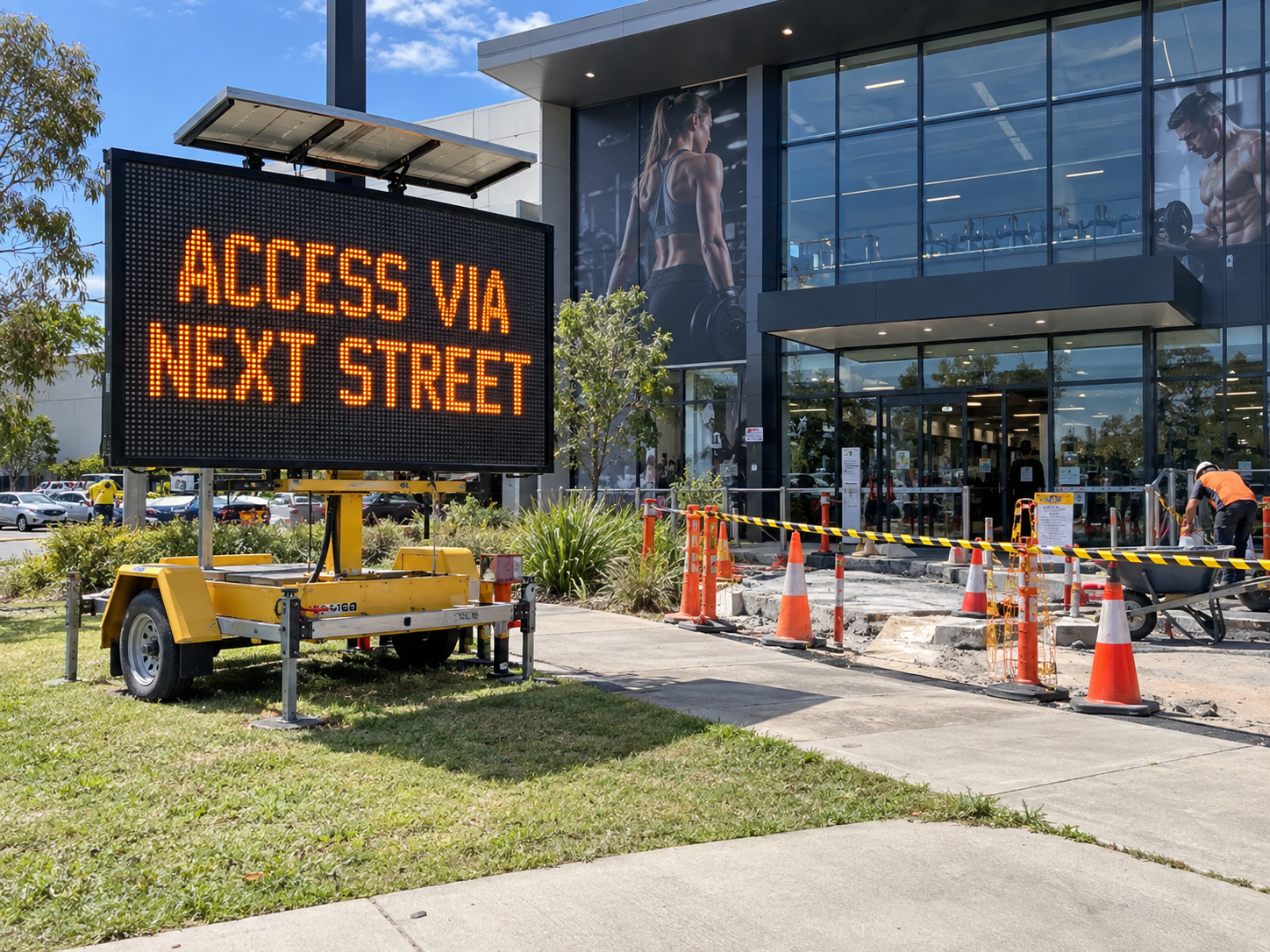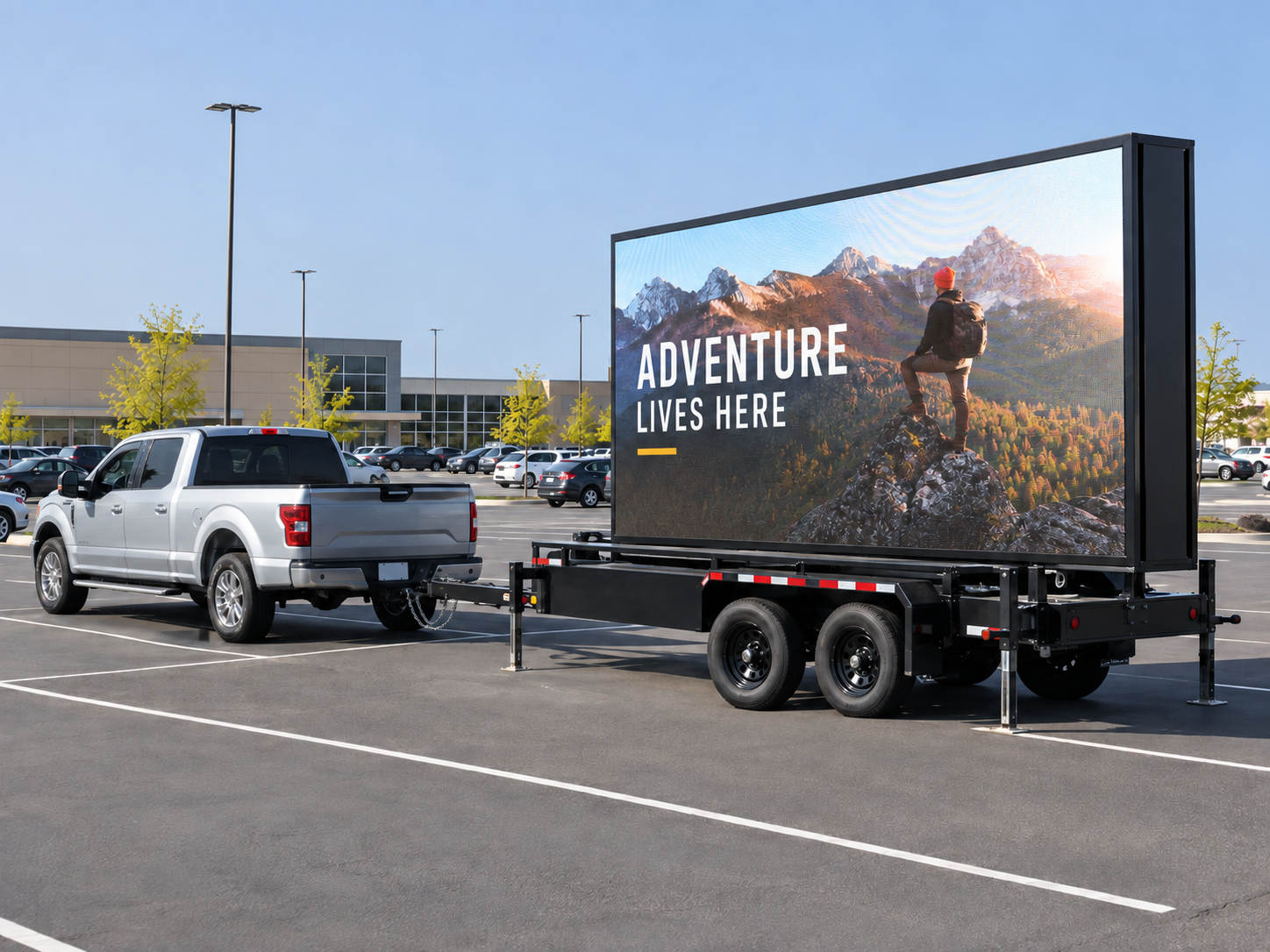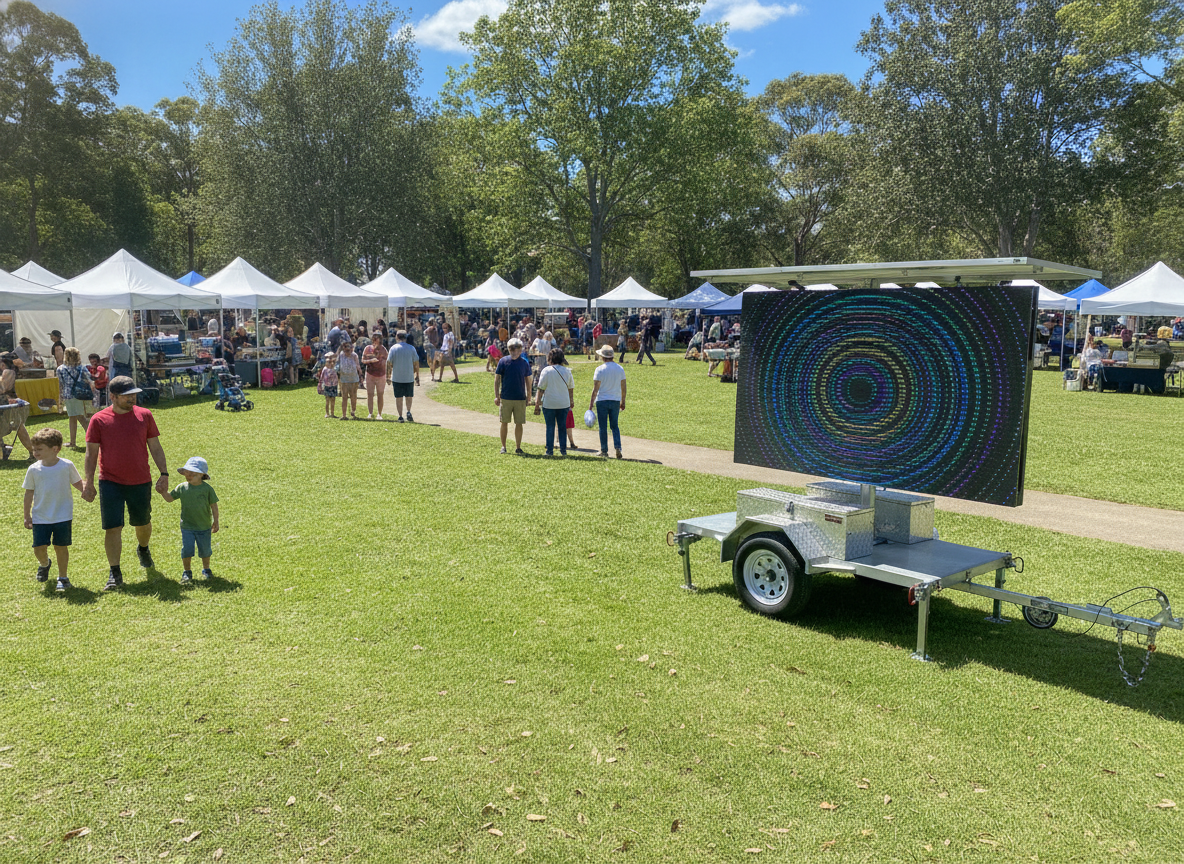
Hiring a mobile LED billboard for the first time is an exciting way to make a business, promotion or event more visible. A bright digital display can help announce a grand opening, promote a dealership sale, attract visitors to an open home, publicise a community event or place a time-sensitive offer directly in front of a local audience.
The best campaigns, however, begin well before the screen is switched on.
A successful hire depends on more than choosing dates and supplying a logo. The campaign objective needs to be clear. The proposed site needs to be suitable and accessible. The person responsible for the property should approve the placement. Artwork must be readable in the actual viewing environment. Delivery access, ground conditions, screen orientation, operating hours, content updates, weather planning and collection arrangements all need to be considered.
This guide explains what your business should prepare before a digital billboard trailer arrives. It is designed for first-time customers across the Gold Coast, Brisbane and surrounding areas who want to avoid last-minute problems and make better use of their advertising period.
At Signs of Success, we provide mobile LED advertising trailers for businesses, property professionals, dealerships, retailers, hospitality venues, construction companies, event organisers, community groups and other local organisations. Our signs are solar-powered, self-sufficient and capable of remote content updates, allowing campaigns to operate in locations where fixed power and permanent advertising infrastructure may not be available.
This article focuses on what you, as the customer, can prepare before delivery. You do not need to know every technical detail or have a finished campaign before contacting Signs of Success. Our team can help you refine your message, consider practical placement issues and turn your initial idea into a clear campaign plan.
Begin with a clear campaign objective and target audience
Before choosing a site, designing artwork or deciding how long to hire the sign, define what the campaign needs to achieve.
A mobile LED sign can attract attention, but attention alone is not the final objective. Your desired result might be increased foot traffic, event registrations, open-home attendance, dealership visits, phone enquiries, website visits, job applications or greater awareness of a new business.
The objective determines almost every other campaign decision. It affects the wording on the screen, the call to action, the operating schedule, the location, the measurement method and the information Signs of Success needs when preparing your hire.
Write down one primary objective. Avoid trying to achieve five unrelated goals with one advertisement. A focused campaign is easier for passing viewers to understand and easier for your team to measure.
Examples of clear objectives include:
| Business or organisation | Practical campaign objective |
|---|---|
| Retail store | Increase visits during a weekend clearance sale |
| Car dealership | Generate test-drive enquiries for selected vehicles |
| Real estate agency | Increase attendance at a Saturday open home |
| Café or restaurant | Promote a lunch offer to nearby workers and passing traffic |
| Event organiser | Increase ticket sales before an upcoming festival |
| Construction company | Announce a project launch or direct visitors to a sales office |
| Employer | Generate applications for specific local vacancies |
| New business | Build awareness and explain where the premises are located |
A vague objective such as “get more exposure” is difficult to translate into effective creative. A more useful objective would be “encourage motorists passing the site to visit our showroom before Sunday afternoon”.
That statement gives Signs of Success a clearer brief. We can then help you consider whether the screen should prioritise the sale name, deadline, location, product image or directional prompt.
Identify the target audience. Ask who should see and respond to the campaign. Is the advertisement aimed at commuters, nearby residents, families, tourists, property buyers, tradespeople, event attendees, business owners or jobseekers?
Audience information helps determine both placement and content. A campaign aimed at morning commuters may require different operating hours and wording from a campaign aimed at weekend shoppers. A property campaign might prioritise viewers already driving near the listing, while a recruitment campaign may need to explain the role and application action more directly.
Outdoor advertising is strongly influenced by its location and the circumstances in which people see it. The Outdoor Media Association’s creative guidance distinguishes between short viewing opportunities for passing motorists and longer viewing periods for people who are waiting or walking. It advises advertisers to adapt the format and amount of information to the audience’s likely dwell time.
For a roadside mobile digital billboard, your audience may have only a few seconds to recognise the brand, read the offer and understand what to do next. That usually means one main message, one strong visual and one clear action.
For a portable LED billboard positioned inside an event venue, showroom forecourt or pedestrian area, viewers may have longer to read. The campaign may be able to rotate event times, sponsor messages, maps, menus or several calls to action.
Decide what action the viewer should take. Common calls to action include:
| Desired action | Possible screen wording |
|---|---|
| Enter the premises | “Sale On Now — Turn Left” |
| Attend an event | “Food Festival This Saturday” |
| Visit an open home | “Open Home Today — 11.00 am” |
| Make an enquiry | “Book a Test Drive Today” |
| Visit a website | “View Available Lots Online” |
| Scan a code | “Scan for Tickets” |
| Apply for a role | “Now Hiring Local Drivers” |
| Remember the brand | Brand name, service and suburb |
The call to action must suit the viewing context. A long web address is rarely ideal for motorists. A short, memorable domain, simple direction or prominent business name may be more practical. A QR code can work where pedestrians or stationary audiences have sufficient time and can approach safely, but it should not be the only response method in a fast roadside environment.
Choose a realistic success measure. A local campaign can be tracked through a dedicated promotional code, campaign-specific landing page, separate enquiry number, QR code, point-of-sale question or comparison of visits and enquiries before, during and after the hire.
Outdoor campaigns can also be evaluated through audience movement and exposure data. Australia’s outdoor advertising industry uses MOVE to support campaign planning and measurement across billboard, transport, retail and other out-of-home environments, including hourly and seasonal audience patterns.
A small local business may not need a complex measurement platform. The important step is to decide what evidence will show whether the campaign helped. Signs of Success can discuss practical tracking options when you request a quote.
Confirm dates, operating hours, permissions and approvals
Once the objective is clear, the next step is to establish exactly when and where the campaign will operate.
Select preferred dates and alternative dates. Tell Signs of Success the date on which the advertisement must be live, not just the date of the event itself. A campaign may need to begin several days before a grand opening, sale, festival or auction.
Include:
| Timing detail | Information to provide |
|---|---|
| Preferred delivery date | The earliest suitable date and time |
| Campaign start | When the screen should begin operating |
| Campaign finish | When the final message can stop |
| Collection window | When the trailer can be removed |
| Essential peak periods | Morning commute, lunch, afternoon, evening or weekend |
| Alternative dates | Useful where the event or site is weather-dependent |
| Content deadlines | When approved wording and artwork will be supplied |
Book early where possible. Availability is only one reason. A longer lead time allows you to assess the site, obtain permission, confirm whether any council or road authority requirements apply, prepare artwork and allow internal stakeholders to approve the content.
Decide on operating hours. A mobile electronic billboard does not always need to display the same advertisement continuously throughout the entire hire.
Consider when the target audience is most likely to pass the site. A café may focus on morning and lunchtime trade. A dealership may prioritise commuting periods and weekend shopping hours. An event venue may need promotional content before the gates open, directional information during arrivals and sponsor or schedule content once attendees are inside.
Signs of Success can remotely update content, which means the advertising can change as the campaign progresses. A retailer could begin with “Sale Starts Friday”, move to “Sale Now On”, and finish with “Final Day Today”. A property campaign could change from an advance open-home announcement to “Open Home Today”.
Operating hours should also consider the surrounding environment. Evening brightness, nearby residences, venue opening times, security, neighbourhood amenity and applicable approval conditions may all affect when an illuminated sign can operate.
Confirm who controls the proposed property. Do not assume that a tenant, event coordinator, store manager or marketing agency automatically has authority to approve trailer placement.
Obtain written agreement from the property owner, authorised occupier, centre management, body corporate, venue operator or other responsible party. The written confirmation should identify:
- the precise area where the unit may be positioned;
- the approved campaign dates and hours;
- the delivery and collection arrangements;
- any access restrictions;
- any site induction or contractor requirements;
- responsibility for permits or applications;
- emergency and after-hours contacts.
Written permission is especially important where the proposed site is part of a shopping centre, shared commercial complex, school, sports facility, development site or body corporate property.
In Brisbane, an applicant who is not the owner of the relevant land must provide the landowner’s consent when applying for advertising device approval. Brisbane City Council also asks for accurate site plans and design or construction details as part of relevant applications.
Check whether approval is required. The fact that a billboard is portable or mounted on a trailer does not automatically mean it can be placed anywhere without permission.
Requirements can depend on the council area, property, zoning, screen type, sign area, illumination, campaign content, visibility from public land, proximity to a state-controlled road and the way the trailer is being used. Approval categories and exemptions can also differ between locations.
On the Gold Coast, the City advises that an advertising sign visible from a public place may require an advertising sign licence. Illumination is one of the factors that can bring a sign within the application process. The City says applications should be submitted with supporting documents at least 30 business days before the proposed display date, although the precise requirements depend on the sign and site.
Gold Coast applications may require a site plan showing nearby buildings, driveways and footpaths, together with sign drawings, dimensions, support details, materials and illumination information. A certificate of currency for at least $20 million in public liability insurance is requested where a sign is on or over a public place. Additional engineering or specialist reporting may be requested where safety or amenity could be affected.
In Brisbane, advertising devices may be prohibited, permitted through self-assessment or subject to council approval. Brisbane City Council states that high-impact electronic display signs, including some electronic or LED billboards, are prohibited in certain locations. Illuminated and electronic displays must also meet applicable technical standards.
These differences are why site details should be discussed early. Do not rely on a general assumption that a previous campaign, nearby sign or similar-looking trailer proves that your proposed use is permitted.
Check the road authority as well as the council. Advertising visible from a state-controlled road may be affected by Queensland Department of Transport and Main Roads requirements, even when the sign itself is positioned outside the road boundary.
Transport and Main Roads advises that roadside advertising should not obstruct or distract a driver’s view of official signs, intersections, ramps or other decision-making areas. Its guidance also addresses brightness, colour, movement, content, supporting structures and the relationship between the device and the road environment.
This is general preparation information, not legal advice. Approval requirements can change and must be assessed against the specific location and proposed use. Signs of Success can help you identify the practical information needed for a site discussion, but the property controller and advertiser should confirm applicable permissions with the relevant council, road authority or qualified adviser before installation.
Prepare the location for delivery, positioning and safe setup
A site may look spacious when viewed from the road but still be unsuitable for an LED trailer. The delivery vehicle must be able to enter, manoeuvre, position the unit and leave without damaging the property or obstructing other users.
Send Signs of Success clear information about access before the delivery date. Photos and a simple marked-up site plan can prevent confusion and may identify problems that are difficult to explain over the phone.
Provide the exact address and setup point. A street address alone may not be enough for a large shopping centre, dealership, school, event ground or construction site.
Mark the intended position on an aerial image or site map. Include the preferred entry gate, driveway, internal route and screen-facing direction. For a multi-tenant property, identify the relevant tenancy and the part of the frontage allocated to the campaign.
A helpful site pack may include:
| Site information | What to show |
|---|---|
| Street address | Full address and suburb |
| Entry point | Gate or driveway to be used |
| Internal route | Turns, ramps, bollards and narrow areas |
| Final position | Marked trailer footprint |
| Screen direction | The audience or traffic approach |
| Nearby objects | Trees, poles, awnings, signs and parked vehicles |
| Restricted areas | Fire access, loading zones and pedestrian routes |
| Contact location | Where the on-site representative will meet the driver |
Check vehicle access. Consider whether the towing vehicle and trailer can negotiate the entire route, not merely whether a car can enter.
Look for narrow gates, sharp turns, low awnings, height bars, speed humps, steep transitions, soft verges, landscaped islands, kerbs, parked vehicles and locked access points. Check whether the delivery route changes outside normal business hours.
Advise Signs of Success if the delivery must occur through a loading dock, controlled gate, construction entrance or venue service road. Provide access codes, booking procedures and site induction requirements in advance.
Where possible, keep the access route clear for the agreed delivery window. A space that is available when the quote is requested may be occupied by customer cars, temporary fencing, pallets, food trucks, event equipment or construction materials on the day.
Assess the available space. The setup area needs enough room for the trailer itself and the operational components required to stabilise and display the screen. Do not measure only the visible billboard panel.
Ask Signs of Success to confirm the space and access requirements for the unit being supplied. Share measurements if the proposed position is constrained by buildings, property boundaries, fences, other signs or landscaping.
The trailer should not block:
- pedestrian paths or accessible routes;
- driveways and vehicle sight lines;
- fire exits or emergency access;
- loading bays required during the hire;
- official traffic signs;
- customer parking circulation;
- venue queues or evacuation paths;
- access to utility infrastructure.
Queensland roadside guidance places strong emphasis on site selection and the relationship between advertising devices, road signs, sight distances and driver decision points. It recommends that advertising content be quickly and easily interpreted and that devices not be shaped, coloured or illuminated in a way that could be confused with official traffic signs.
Brisbane’s technical standards similarly identify roundabouts, intersections, school zones, railway crossings, pedestrian facilities and complex road configurations as areas requiring additional driver attention. These factors can influence whether a proposed electronic display location is suitable or needs further assessment.
Inspect the ground conditions. A level, firm and stable area is generally preferable to loose, wet, steep or uneven ground.
Tell Signs of Success if the proposed location consists of grass, gravel, compacted road base, asphalt, concrete, pavers or another surface. Report visible slopes, drainage channels, soft edges, recent excavation, underground tanks, irrigation components or areas prone to pooling water.
Do not assume that a dry grassed area will remain suitable after heavy rain. South East Queensland conditions can change quickly, and access across soft ground may be very different after a storm.
If the campaign is associated with a festival, construction project or temporary venue, confirm whether the site layout will change before delivery. Temporary fencing, marquees, barricades, generators and vendor vehicles can alter access and sight lines.
Look above and around the setup area. Note overhead branches, powerlines, awnings, shade sails and building projections. The raised display must have sufficient clearance and should not interfere with surrounding structures.
Also identify underground services or site restrictions that may affect stabilisation and positioning. The customer or property representative is usually best placed to identify private infrastructure that is not obvious during delivery.
Plan the screen orientation. The best position is not necessarily the closest position to the road.
Consider where the intended audience first sees the screen, the direction from which people approach, their likely speed, competing visual clutter, sunlight, shadows, parked vehicles and whether trees or street furniture interrupt the viewing line.
A screen facing directly towards the wrong traffic movement may receive less useful exposure than one angled towards the dominant approach. At an event, the screen may need to face an entry queue rather than the road. At a dealership, it may need to catch passing traffic while still allowing a clear view into the premises.
The Outdoor Media Association describes out-of-home advertising as location-driven and recommends matching creative and placement to the local context. Its guidance also notes that motorists passing a billboard may have a very short viewing opportunity, whereas pedestrians or waiting audiences can engage for longer.
Signs of Success can help you think through viewing direction before final placement. Sending photos taken from the audience’s approach is often more useful than sending a close-up photo of the empty setup area.
Consider daylight and night-time conditions. Visit or photograph the proposed site at the times when the advertisement will operate.
A position that is clearly visible at midday may be affected by late-afternoon glare. A location that looks bright and active during business hours may be very dark after closing. Nearby streetlights, illuminated shopfronts and fixed signs can also affect contrast.
Outdoor electronic advertising should not be excessively bright or create glare for road users. Transport and Main Roads applies luminance controls to illuminated devices and prohibits certain flashing point light sources that could resemble emergency or special-purpose vehicle lights.
Content that appears vivid on a computer monitor should therefore still be designed for controlled, comfortable outdoor viewing. Signs of Success can assist with screen-appropriate creative rather than simply displaying an untested file.
Distinguish the advertising screen from the road-going lights. Customers searching for led trailer lights are sometimes referring to the advertising display, while others mean the trailer’s normal brake lights, indicators, tail-lights and marker lights.
Search phrases such as trailers lights and led lights trailer lights can therefore create confusion. In this campaign checklist, the two systems have different roles:
| Lighting component | Purpose |
|---|---|
| LED advertising screen | Displays promotional or informational content |
| Brake and tail-lights | Communicate braking and vehicle presence while towing |
| Direction indicators | Show intended turns during transport |
| Clearance or marker lights | Help indicate the trailer’s dimensions where fitted |
| Numberplate lighting | Illuminates the registration plate where required |
Queensland vehicle inspection guidance treats the correct operation and condition of park or side lights, brake lights, tail-lights, indicators, clearance or side-marker lights and numberplate lights as part of trailer safety inspection considerations.
Signs of Success manages the delivery and setup of its equipment, but customers can assist by ensuring the access route is unobstructed and that parked vehicles, temporary structures or vegetation do not interfere with safe arrival and departure.
Prepare artwork, wording and content approvals
Strong equipment cannot compensate for unclear advertising. A bright mobile electronic billboard with too much text may be less effective than a simple screen containing one memorable offer.
Creative preparation should begin with the real viewing conditions, not with the amount of information your business would like to include.
Write the main message first. Before opening design software, complete this sentence:
“After seeing this screen for a few seconds, the viewer should know ________.”
A useful answer might be:
- the sale is happening now;
- the new store is open;
- the event is this Saturday;
- the open home begins at 11.00 am;
- the dealership is offering test drives;
- the business is recruiting;
- visitors should enter through the next driveway.
If the sentence contains several unrelated ideas, the campaign may need a sequence of screens rather than one crowded layout.
Prioritise information. A practical content hierarchy is:
| Priority | Typical content |
|---|---|
| First | The offer, event or central message |
| Second | Brand or business name |
| Third | Date, time, location or deadline |
| Fourth | One clear call to action |
| Optional | Supporting image, short condition or campaign code |
Not every campaign needs every element. A sign positioned directly outside a recognisable dealership may not need a full address. An off-site event advertisement may need the suburb or venue. A directional message may need a large arrow and very little else.
Keep roadside copy brief. The amount of text should reflect the available viewing time.
The Outdoor Media Association’s guidance indicates that audiences driving past billboards or high-transit formats may engage for only a few seconds. It recommends creative that is easy to see, read and remember, with shorter content for moving audiences and longer content only where viewers have more time.
Transport and Main Roads likewise advises that roadside advertising should be easily discernible and quickly interpreted. Its technical guidance notes that excessive words can reduce the effectiveness of the device and extend the period during which a driver is distracted.
Compare these examples:
| Weaker roadside message | Clearer alternative |
|---|---|
| “Come and celebrate the opening of our exciting new store with discounts across a wide range of products” | “GRAND OPENING — 20% OFF TODAY” |
| “Our dealership has a number of vehicles available for immediate delivery this weekend” | “CARS READY NOW — OPEN SATURDAY” |
| “Join us at the community festival featuring food, entertainment and activities for the entire family” | “FAMILY FESTIVAL — THIS SUNDAY” |
| “We are currently seeking qualified and experienced people to join our growing local team” | “NOW HIRING — APPLY TODAY” |
The shorter version creates room for larger lettering, stronger contrast and a clearer action.
Prepare more than one message where useful. A major benefit of mobile electronic signs is the ability to change content without producing a new physical banner.
A campaign sequence might include:
| Campaign stage | Message example |
|---|---|
| Advance promotion | “New Store Opens Friday” |
| Launch | “Grand Opening Today” |
| Peak trading | “Opening Sale Now On” |
| Final urgency | “Sale Ends 5 pm” |
| Post-event | “Thank You Gold Coast” |
Signs of Success can update content remotely, allowing the screen to remain relevant when the campaign moves from anticipation to launch, live promotion and final-day urgency.
Do not rotate messages simply because the technology allows it. Every additional screen creates another decision about sequence, dwell time and readability. Use several messages when they support the campaign, not when they divide attention.
Brisbane’s technical standards specify minimum dwell-time considerations for changeable electronic content visible from roadways. The applicable setting depends partly on the speed environment and assessment of the particular site.
Plan daypart content. Different messages can be prepared for morning, afternoon and evening audiences where the campaign objective justifies it.
A restaurant could display breakfast content during the morning commute, lunch messaging around midday and dinner or event content later in the day. A festival could promote ticket sales before opening and change to parking, entry or schedule information once the event begins.
A dealership could highlight service-booking availability in the morning and vehicle offers during the afternoon. A construction development could promote inspections during scheduled sales hours and use a general brand message at other times.
Provide Signs of Success with a simple schedule showing:
| Time period | Approved content |
|---|---|
| Morning | File name or message reference |
| Midday | File name or message reference |
| Afternoon | File name or message reference |
| Evening | File name or message reference |
| Final day | Urgency or deadline creative |
| Contingency | Cancellation, postponement or changed-hours message |
Confirm file requirements before designing. Do not assume that artwork made for Instagram, a website banner, print brochure or television screen will automatically fit an LED display.
Ask Signs of Success for the required pixel dimensions, orientation, accepted file types, duration requirements and any limits applying to animation or video. These specifications may depend on the particular screen and campaign.
Provide original, high-quality brand assets where possible, including:
- vector or high-resolution logos;
- approved brand colours;
- product or venue images;
- font files or authorised alternatives;
- exact offer wording;
- mandatory terms;
- contact details;
- final dates and operating times.
Avoid taking a small logo from a website and enlarging it. Low-resolution files may appear pixelated or soft when displayed at billboard scale.
Design for distance. Fine print, thin fonts and subtle colour differences may look attractive on a laptop but disappear when viewed from across a forecourt or by passing traffic.
Use large type, strong contrast and a restrained layout. Leave enough empty space around important elements. Test the design at a reduced size or step several metres away from the monitor. The viewer should still be able to identify the offer immediately.
A roadside advertisement should not imitate an official traffic sign or use visual effects that could create confusion. Queensland guidance addresses shapes, colours, illumination and movement that may interfere with the recognition of official road information.
Use animation cautiously. The screen’s capability does not mean that rapid flashing, constant motion or complicated transitions are appropriate.
The safest and clearest approach in a roadside environment may be a static or gently changing creative, subject to the location and applicable approval conditions. Queensland road guidance restricts certain moving, rotating and flashing formats in road environments because of their potential to distract motorists.
For pedestrian-facing event content, controlled animation may be appropriate, but it should still support the message rather than compete with it.
Nominate the content approver. One person should have authority to give final written approval.
Campaign delays often occur when several stakeholders provide conflicting changes. The marketing manager may change the headline, the venue may change the time, the legal team may add conditions and the business owner may replace the offer shortly before launch.
Establish:
| Approval responsibility | Named person |
|---|---|
| Offer and price accuracy | Business representative |
| Dates and event times | Event or operations representative |
| Brand compliance | Marketing representative |
| Legal terms | Authorised legal or management contact |
| Final screen approval | One nominated decision-maker |
| Emergency update approval | Primary and backup contact |
Supply all changes in writing. Verbal instructions can be misheard, particularly where numbers, dates, prices and addresses are involved.
Proofread every screen for spelling, punctuation and factual accuracy. Check that weekdays match dates, prices are correct, offer exclusions are approved and telephone numbers work.
Separate hiring intent from purchasing intent. Searchers comparing mobile advertising options may encounter phrases such as mobile digital billboards for sale, mobile LED billboard for sale and mobile LED signs for sale.
Buying a unit is a different decision from hiring one. Ownership can involve capital expenditure, registration, towing, storage, maintenance, screen management, software, battery or solar systems, roadworthiness and responsibility for deployment.
For businesses running occasional promotions, hiring may be more practical because the equipment, delivery and campaign support are available when required without the long-term obligations of ownership. Signs of Success already provides a dedicated comparison of mobile LED sign hire and billboard purchase considerations.
This hire checklist therefore assumes that your business wants campaign support rather than responsibility for owning and operating a trailer.
Plan content updates, tracking, weather and campaign completion
Preparation should cover the entire hire period, not only delivery day.
A well-managed campaign has a clear operating contact, approved update process, measurement plan, weather response and collection arrangement.
Nominate an on-site contact. This person should be available during delivery and know where the trailer has been approved for placement.
Provide:
| Contact detail | Information needed |
|---|---|
| Name | Person authorised to meet the delivery team |
| Mobile number | Number answered during the delivery window |
| Backup contact | Alternative person if the primary contact is unavailable |
| Access authority | Confirmation that the person can open gates or approve entry |
| Site knowledge | Awareness of the exact position and restrictions |
| After-hours contact | Required for evening or weekend campaigns |
The on-site contact should not need to search for a manager, request a new parking area or renegotiate permission while the delivery vehicle waits.
Agree on the update process. Decide before launch who can request a screen change and how much notice should be allowed.
An update request should identify:
- the campaign or trailer;
- the screen to be replaced;
- the exact approved replacement;
- the required activation time;
- the person authorising the change;
- whether the old content may be restored later.
Maintain version control. File names such as final.jpg, final-new.jpg and final-new-2.jpg make errors more likely. Use descriptive names such as Grand-Opening-Advance, Grand-Opening-Live and Grand-Opening-Final-Day.
Signs of Success can assist with remote content updates, but approved material should be supplied in a clear and organised form.
Prepare contingency messages. Events and promotions can change after the trailer is delivered.
Create approved backup wording for foreseeable scenarios:
| Scenario | Possible update |
|---|---|
| Event postponed | “New Date Coming Soon” |
| Wet-weather move | “Event Moved Indoors” |
| Tickets sold out | “Sold Out — Thank You” |
| Session full | “Next Session 2 pm” |
| Offer exhausted | Alternative product or brand message |
| Opening delayed | Revised opening date |
| Access changed | Updated entry or parking direction |
| Emergency closure | Clear closure notice |
A digital display is valuable in these situations because content can be changed without printing and physically replacing a banner. The ability to update does not remove the need for an approval process; it makes advance contingency planning more worthwhile.
Monitor weather conditions. Outdoor campaigns in South East Queensland may encounter strong sun, wind, rain, humidity and rapidly changing conditions.
Tell Signs of Success about known exposure issues at the proposed site. An open coastal location, elevated development site or unprotected event ground may present different conditions from a sheltered commercial forecourt.
Do not move, adjust or interfere with the trailer after professional setup unless instructed by Signs of Success. Contact the team if site conditions change, access becomes unsafe or severe weather affects the campaign.
Your internal event or site plan should identify who can decide whether the location remains operational and who will contact Signs of Success. For regulated events or construction sites, integrate the trailer into the broader site safety and emergency plan.
Protect access throughout the hire. A suitable position can become unsuitable when other activities begin around it.
Monitor whether parked vehicles block the screen, stock deliveries restrict collection access, event fencing changes, grass becomes waterlogged or new equipment is placed near the trailer.
Avoid storing items against the unit. Keep the immediate area clear of waste, promotional furniture, temporary signs and unauthorised cables.
If another contractor needs to work nearby, inform Signs of Success before the setup is disturbed.
Track enquiries consistently. Tell staff that the campaign is running and how responses should be recorded.
A customer may not say, “I saw your mobile billboard”. Staff can ask a simple question such as “How did you hear about the sale?” and record the response in the point-of-sale or customer relationship management system.
Useful tracking methods include:
| Method | Best use |
|---|---|
| Dedicated landing page | Campaigns driving online research or bookings |
| Short promotional code | Retail, hospitality and ticketing offers |
| Campaign phone number | Enquiry-led services |
| QR code | Pedestrian, queue or event audiences |
| Website traffic comparison | Awareness campaigns with a digital response |
| Footfall comparison | Retail, showroom and event campaigns |
| Staff question | Businesses with in-person enquiries |
| Lead-source field | Recruitment, property and service enquiries |
Compare results with an appropriate baseline. A Saturday event should generally be compared with similar Saturdays rather than an unrelated weekday. Note other factors such as weather, concurrent promotions and seasonal demand.
Do not assess the campaign only by immediate sales. A mobile digital billboard may also support brand recognition, location awareness and future enquiries. Nevertheless, the closer the call to action is to the measurable business result, the easier it will be to evaluate.
Confirm collection arrangements. Collection should be treated as part of the booking, not an afterthought.
Advise Signs of Success if gates lock at a particular time, the venue closes after the event, traffic management will be removed, security access changes or the trailer must leave before other contractors.
Keep the route clear. Remove temporary barriers and ensure the collection contact is available. Tell the team if wet ground, construction work or changed parking arrangements have affected access since delivery.
At the end of the campaign, record:
| Completion item | Detail |
|---|---|
| Final operating time | When content stopped |
| Collection time | Actual removal time |
| Campaign enquiries | Calls, visits, scans or applications |
| Operational issues | Access, weather or visibility concerns |
| Best-performing message | Where multiple creatives were used |
| Future improvement | What should change next time |
| Rebooking opportunity | Next sale, event or campaign date |
This short review helps Signs of Success understand what worked and makes the next campaign easier to prepare.
Use this printable mobile LED billboard hire checklist
The following checklist can be copied into a document, printed or completed before requesting a quote.
| Check | Information to prepare |
|---|---|
| ☐ | The primary campaign objective |
| ☐ | The target audience |
| ☐ | The main offer, event or announcement |
| ☐ | The action viewers should take |
| ☐ | Preferred campaign dates |
| ☐ | Alternative dates, where relevant |
| ☐ | Required operating hours |
| ☐ | Exact site address |
| ☐ | Marked setup position |
| ☐ | Screen-facing direction |
| ☐ | Property owner or authorised occupier approval |
| ☐ | Council or road authority checks, where applicable |
| ☐ | Delivery gate, driveway or loading access |
| ☐ | Gate codes, bookings or site induction requirements |
| ☐ | Available setup space |
| ☐ | Ground surface and slope information |
| ☐ | Photos of the site and audience approach |
| ☐ | Details of overhead or surrounding obstructions |
| ☐ | On-site delivery contact |
| ☐ | Backup and after-hours contact |
| ☐ | Final headline and call to action |
| ☐ | Correct dates, prices and contact details |
| ☐ | Logo and high-quality images |
| ☐ | Artwork prepared to Signs of Success specifications |
| ☐ | Content approver’s name |
| ☐ | Message rotation schedule |
| ☐ | Morning, afternoon or evening variations |
| ☐ | Contingency messages |
| ☐ | Campaign tracking method |
| ☐ | Weather and emergency contact process |
| ☐ | Collection time and access arrangements |
When requesting a quote, send Signs of Success as much of this information as you already have. A concise initial brief could read:
We are a car dealership in Southport planning a three-day sales event from Friday to Sunday. We would like the screen visible to northbound traffic and operating during morning and afternoon peak periods. The proposed setup area is on our private forecourt, and the property manager has approved the location. We have a logo and vehicle images but would like assistance simplifying the message. Our objective is to increase showroom visits and test-drive enquiries. Photos and a marked site plan are attached.
That brief is far more useful than a message asking only, “How much is a billboard?” It helps the Signs of Success team consider availability, delivery, site access, positioning, content needs and the overall campaign requirements.
How early should you contact Signs of Success? Contact the team as soon as your dates and approximate location are known. Early contact is particularly important where property permission, council approval, a state-controlled road, event coordination or custom creative may be involved. On the Gold Coast, the City advises that relevant advertising sign licence applications and supporting documents should be lodged at least 30 business days before display.
Can Signs of Success help if the artwork is not ready? Yes. You can begin the conversation with your objective, offer, audience and available brand assets. Signs of Success can help you think through clear wording and screen-suitable content. The company’s service is designed around campaign visibility, placement and practical support rather than merely supplying equipment.
Can the message change after setup? Signs of Success provides remote content-update capability, so approved content can be changed as the promotion develops. Plan expected changes in advance and nominate the person authorised to approve them.
Should you hire or buy? Businesses searching for mobile digital billboards for sale, a mobile LED billboard for sale or mobile LED signs for sale may be considering ownership. Hiring is generally better aligned with occasional campaigns, events and promotions where the business does not want to manage storage, towing, maintenance and deployment between uses. Signs of Success offers local hire support for businesses that want the benefits of mobile digital advertising without buying the equipment.
What does “rent LED trailer” mean in practice? When someone searches rent LED trailer, they may expect a basic equipment rental. Signs of Success offers a more supported service: a professionally supplied advertising trailer, campaign planning assistance, delivery and setup considerations, placement guidance and remote content flexibility.
What information is essential when you hire mobile LED sign advertising? At minimum, provide the location, preferred dates, business or event type, campaign objective, intended audience, available artwork and the name of the person responsible for the site. From there, Signs of Success can help identify what else is needed.
A mobile billboard campaign becomes much easier when the objective, property approval, access, position and content are resolved before delivery. Good preparation reduces delays, protects valuable advertising time and gives the screen a better opportunity to communicate one clear message to the right audience.
Signs of Success helps Gold Coast and Brisbane businesses make their promotions impossible to miss through bright, flexible mobile LED advertising trailers. Whether you need a mobile LED sign for a retail sale, a mobile electronic billboard for a launch, a digital billboard trailer for an event or a portable LED billboard for a temporary local campaign, our team can help you plan the hire from first enquiry through to collection.
Contact Signs of Success for more information, practical assistance and a free, no-obligation quote. The team can discuss your campaign dates, proposed location, access, content and advertising objective before recommending the next steps.
Phone: 0405 22 33 66
Email: signsofsuccess@gmail.com
Signs of Success is based on the Gold Coast and serves businesses throughout the region, including Gold Coast and Brisbane clients. Site visits or in-person discussions may also be available for nearby locations.